Tokenized Does Not Mean Instantly Redeemable: Three Redemption Liquidity Models Explained
Picture a borrower on Morpho with a loan backed by mF-ONE, Midas’s private credit token. The position nears liquidation and the borrower needs out today, but the fund behind the token redeems on a cycle of close to 30 days. For the exit to be instant, someone has to pay now, take the token and wait for the fund. Who does that, at what price and up to what size is the real question behind instant redemption. There are three answers: an issuer-funded instant sleeve, an RFQ liquidity market and a standby facility.
Why Tokenized Funds Need an Instant Exit
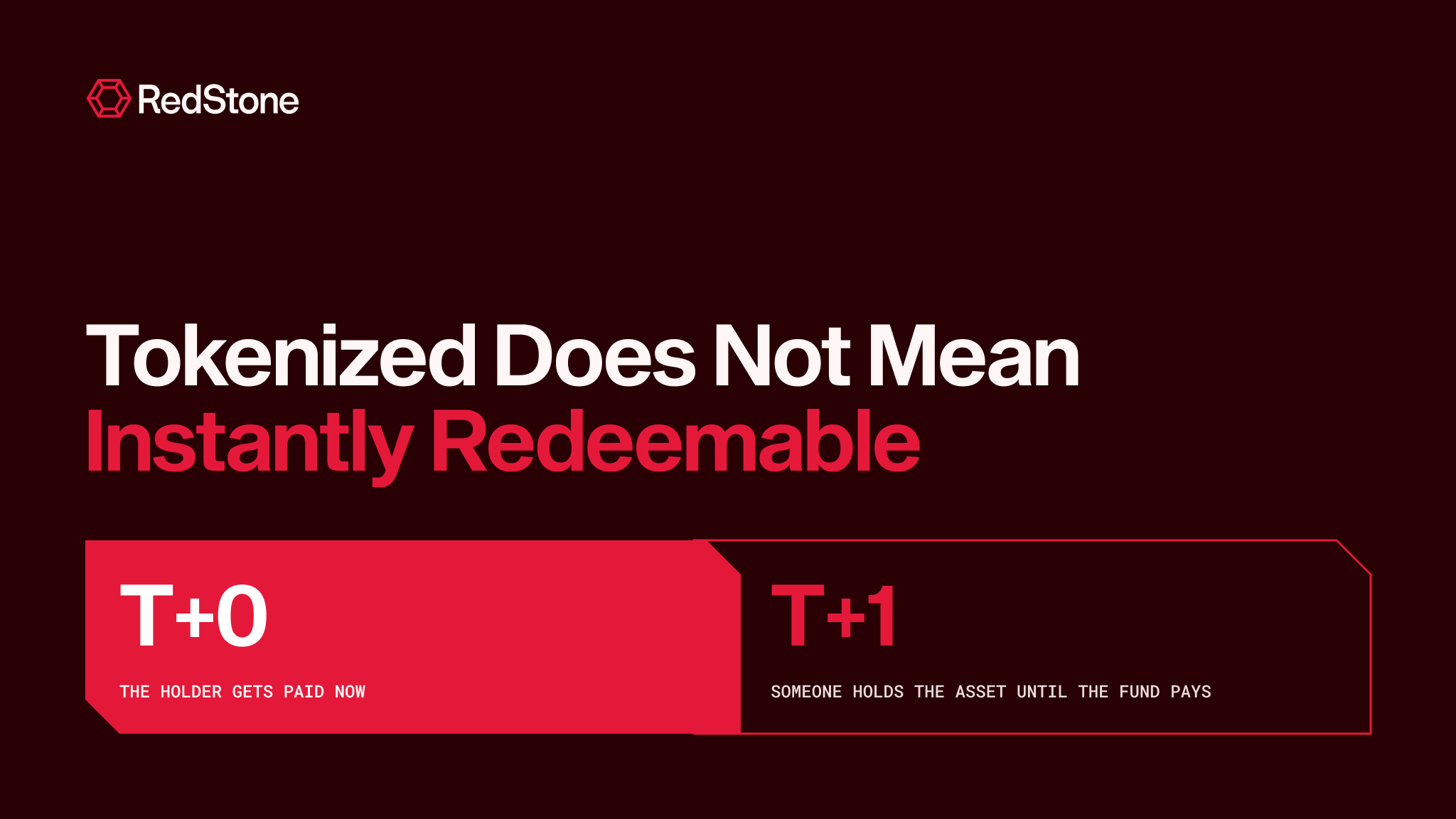
Delivery onchain is instant. Payment is not. A tokenized Treasury fund still has to sell bills and collect cash, so redemption lands at T+1 at best. NYLIM’s HYB fund, tokenized by Centrifuge, redeems at T+3, and a holder may wait up to five business days for cash. Private credit and structured products can take 60 to 180 days.
DeFi users expect the opposite. Sid Powell, Founder and CEO of Maple, says they don’t want to get stuck in a yield product for months. In lending and looping it becomes a requirement, because a position that cannot unwind cannot be liquidated. Nitin Gaur, Head of Institutions at Nethermind, explains why the pressure is rising: near-real-time settlement removes the day treasury teams used to have, so “liquidity risks, treasury risk, duration risks have become on steroids.”
Instant exits get tested in a panic. During the Stream Finance collapse, holders of Midas tokens rushed for the instant route at the same time. That kind of run is exactly what an instant sleeve has to survive, and it only works if a 30-day asset can be exited instantly.
Model 1: The Issuer-Funded Instant Sleeve
An instant sleeve is a pool of liquid assets the issuer keeps next to the token. A holder swaps in and is paid immediately, and the sleeve redeems through the fund later and refills. When mF-ONE was listed on Morpho in June 2025, its instant pool targeted 10% of the token’s TVL. Midas charges a 1% fee for instant redemptions. Maple runs a similar buffer, which Powell puts at “more than 10% of the balance of deposits,” enough for users to get in and out within a few hours.
The catch is that the sleeve is finite and shared. As Steakhouse Financial noted, “any investor can redeem their mF-ONE tokens and deplete the available liquidity.” Once it is empty, everyone waits for the standard cycle, and a borrower facing liquidation waits with them.
Model 2: The RFQ Liquidity Market
In April 2026, Midas announced a second route for mF-ONE holders: an RFQ settlement layer. An RFQ (request for quote) market replaces the issuer’s own pool with competing liquidity providers. Approved providers quote at NAV minus a spread, the best quote wins, and stablecoins move in the same transaction as the token. The provider then redeems through the fund and keeps the spread.
The issuer still sets the rules. It defines a discount floor, which limits how far below NAV a holder can be filled, and for permissioned tokens it restricts bidding to providers that passed KYB/KYC.
The weakness is that nobody is obliged to bid. Depth depends on how much capital providers can commit and how quickly they can access it. Some routes keep provider capital in yield-bearing vaults between settlements, so it doesn’t sit idle while it waits for a request.
Model 3: The Standby Facility
A standby facility is a commitment from a third party, usually a bank or credit fund, to supply liquidity once the sleeve runs dry and bids thin out. It can be undrawn, a committed line that activates on demand for a fee, or pre-funded, with capital parked in a dedicated vault that earns a rate whether or not it is drawn.
The issuer buys guaranteed capacity: known cash on known terms during stress. A bank lending against a tokenized fund has to assess collateral and smart contract risk, work out the capital treatment of stablecoins and find a named legal borrower, which gets awkward when the cash sits in a vault. Onboarding can take months per asset, and capacity stops at the commitment.
Side by Side
| Instant sleeve | RFQ liquidity market | Standby facility | |
|---|---|---|---|
| Who supplies the cash | Issuer | Competing approved LPs | Committed bank or credit fund |
| Who holds the asset during the wait | The sleeve | The winning LP | The facility provider |
| When the holder is paid | Immediately, while it lasts | Atomically, at the winning quote | Immediately, once the sleeve is empty |
| Where the spread sits | None or a small fee; issuer carries funding cost | Discount to NAV, earned by the LP | Commitment fee or funding rate |
| Who sets the price | Issuer, usually at NAV | Competing quotes above the issuer’s floor | Negotiated terms with the provider |
| Capacity | Sleeve size | Depth of the LP pool | Size of the commitment |
| Main constraint | Shared and finite | Bids are not guaranteed | Onboarding and credit review |
| Example | mF-ONE instant pool | mF-ONE RFQ route (April 2026) | Bilateral, usually undisclosed |
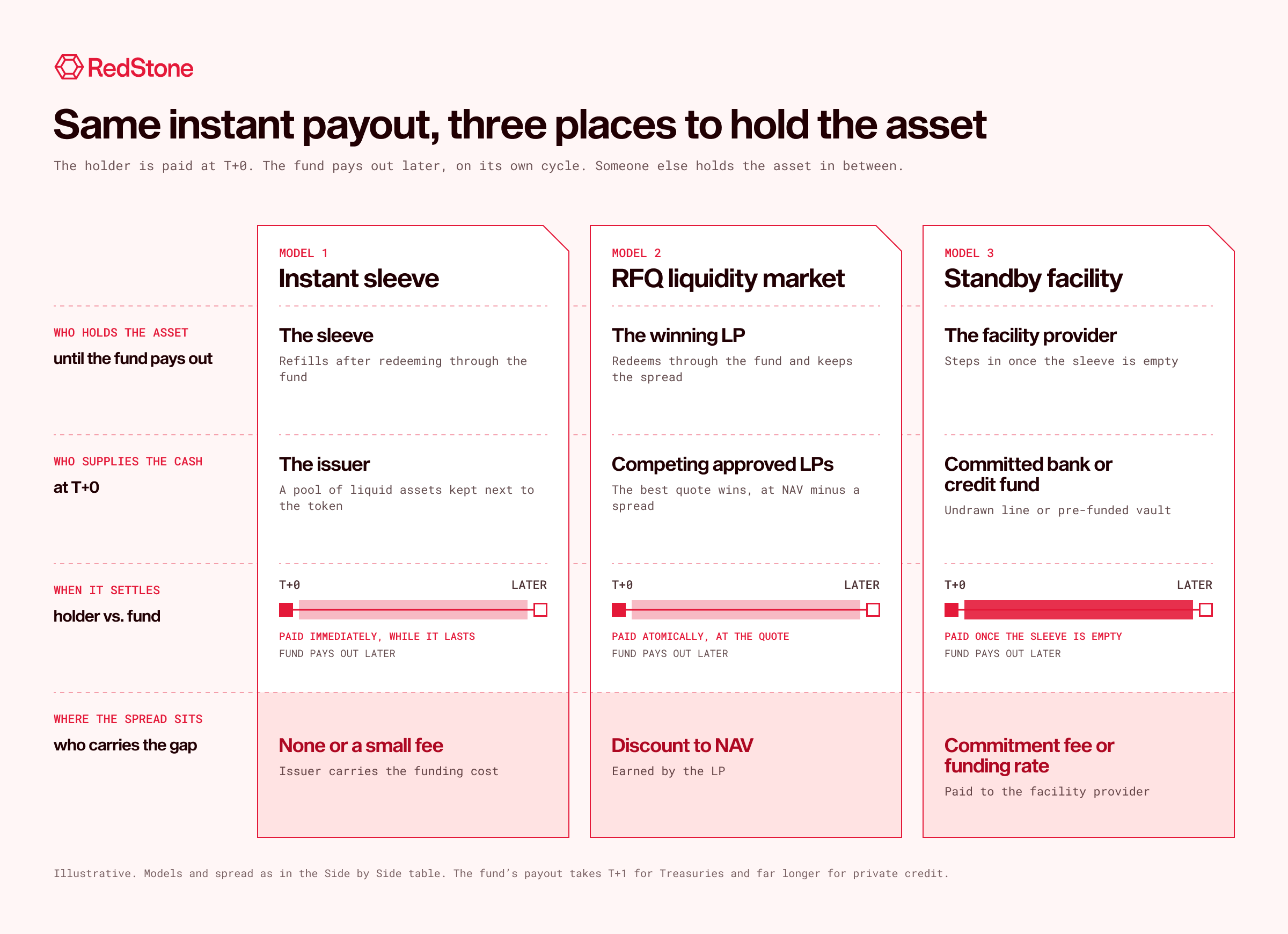
Choosing the Right Mix
The models answer different questions, so mature setups stack them: the sleeve for routine exits, the RFQ market for larger ones, and a standby facility as the backstop for the day bids thin out. mF-ONE already runs the first two.
Not every asset needs all three. T+1 Treasury holders rarely pay for speed. Holders of looped or long-duration positions do, and curators want a backstop in place before listing those assets as collateral, because a liquidation that cannot complete becomes bad debt. The question for an issuer is what its holders need on a bad day: guaranteed capacity, a competitive price, or both.
That menu should grow. Grace Huang Chivers, Director of Product at Grayscale, expects more options once traditional finance, “especially banks,” moves onchain and provides liquidity there.
Frequently Asked Questions
Does instant redemption mean the fund settles at T+0?
No. The holder’s cash leg settles immediately. The fund still redeems on its normal cycle, carried by whoever supplied the cash.
Who pays for instant redemption?
In a sleeve, the issuer, through idle capital and sometimes a small fee. In an RFQ market, the exiting holder, through the discount to NAV. In a standby facility, the issuer, through a commitment fee or funding rate.
Why not just sell on a DEX?
Only while the pool is deep. Pools thin out exactly when exits spike.
What is a discount floor?
The lowest price, relative to NAV, at which the issuer lets liquidity providers buy the token. It caps the discount a holder can face.
Can permissioned tokens use an RFQ market?
Yes. Only providers that passed KYB/KYC can bid, so the token only moves to approved wallets.
Do any of these models change the fund’s terms?
No. All three sit outside the fund, whose subscription and redemption process stays the same.
Which model suits which asset?
A T+1 Treasury fund can usually rely on a sleeve. Private credit and other heavily looped assets tend to need an RFQ market or a committed facility behind it.
RedStone Settle is instant settlement infrastructure for tokenized assets, covering redemptions, liquidations and atomic unwinds of looped positions. It gives token holders near-instant redemption and carries the fund’s redemption cycle on the other side, without taking custody of user funds. Learn more at redstone.finance/settle.
Disclaimer
Informational only. Not an offer, solicitation or recommendation to buy or sell any financial product. RedStone does not issue, manage, advise on or distribute any of the funds or tokens mentioned. Fund information is based on public disclosures by the respective issuers. Not directed at US persons or persons in restricted jurisdictions.