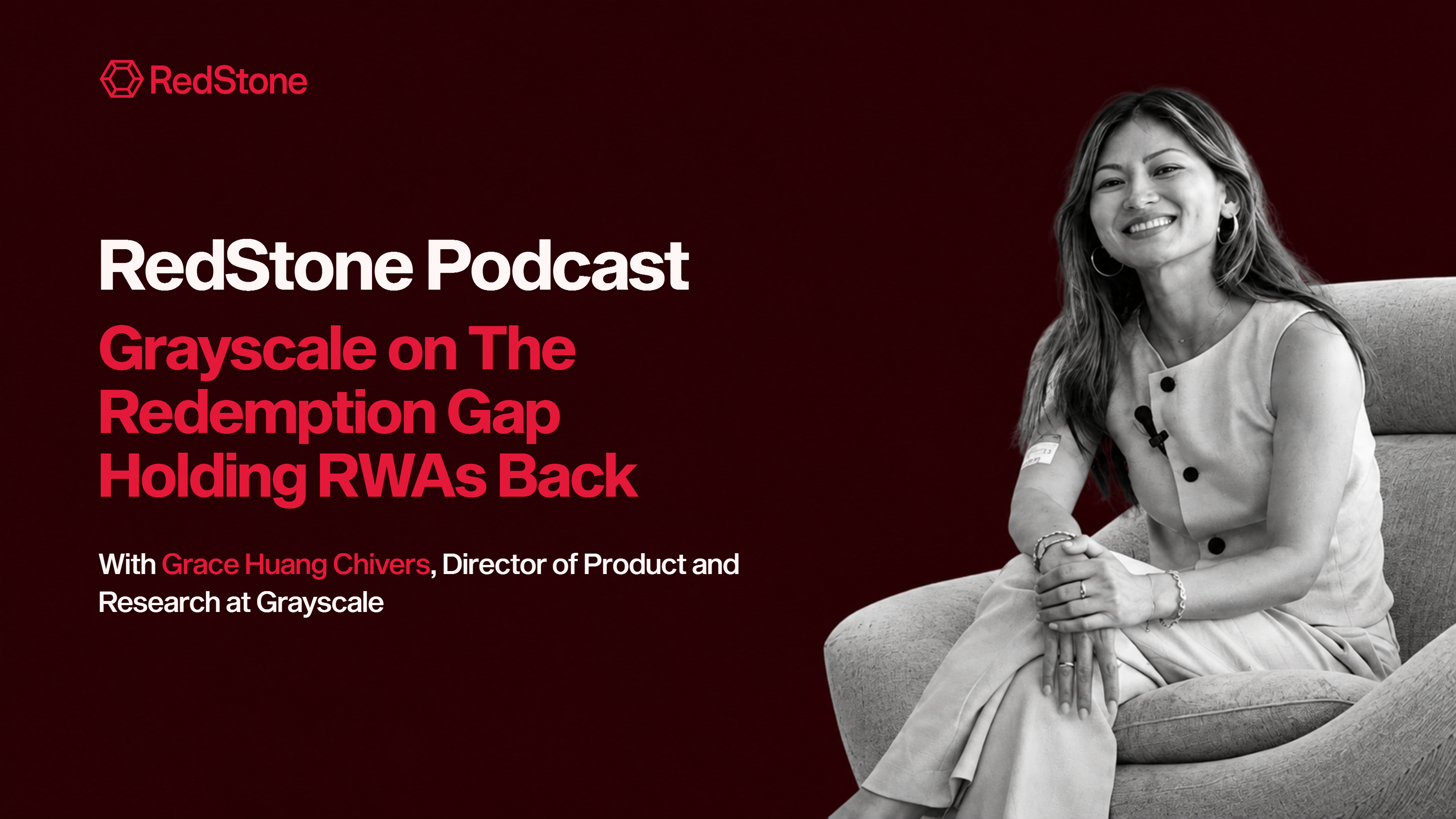
The RedStone Podcast Ep5: Grayscale on The Redemption Gap Holding RWAs Back
Every week on The RedStone Podcast, we sit down with the people building institutional finance onchain for five minutes: long enough to take the industry’s pulse and hear what’s on the mind of the founders, asset managers, and market-infrastructure leaders that are building it.
No long rants or forty-minute origin stories, no filler or padding. This week, Mike Massari, Head of Partnerships at RedStone, sits down with Grace Huang Chivers, Director of Product and Research at Grayscale.
Grace Huang Chivers is Director of Product and Research at Grayscale, one of the largest crypto asset managers in the world. She has been investing in crypto since 2015, and her work sits at the seam between traditional finance and the onchain economy, aligning what Grayscale builds with where institutional capital is willing to go.
For over a decade, Grayscale has been the regulated on-ramp for traditional investors who wanted crypto exposure without buying and holding the assets themselves, most visibly through the Grayscale Bitcoin Trust.
Grayscale was founded in 2013, meaning that it has been around long enough to watch the industry come full circle. Its regulated products opened a door for traditional investors to step into crypto; tokenization is the same bridge running the other way. It takes assets out of traditional markets and puts them onchain, in front of a new audience and with properties they could never have had offchain.
Grayscale has been following the tokenization landscape from a unique point of view, and Grace offers a risk manager’s read on what still has to be true before real assets move onchain at scale.
Three Problems Standing in the Way of Tokenization at Scale
While at this year’s TokenizeThis conference in New York, Grace noticed how an overwhelmingly traditional finance crowd showed up in droves to learn how real world assets (RWAs) move onchain and to see if the infrastructure lives up to the hype. According to her, there’s still a lot to be done, despite the massive progress.
We asked Grace what stands between tokenization and mainstream. Regulation is the first thing that comes to mind. According to her, the law hasn’t caught up on whether an onchain asset confers ownership, and without that certainty, institutions won’t make the first move. Then there is security.
Blockchain technology is permissionless by design. There’s no authority, no moderator or administrator to run to, no supportline to call, The same question that keeps risk officers on their toes is simple, and it’s one that affects retail investors just as much: what happens if it gets hacked.
Last but not least comes liquidity. Tokenizing an asset that has no natural market does not create demand for it. An illiquid offchain asset will simply become an illiquid onchain token. The same can be said for tokens that don’t trade on secondary market or whose redemption windows make it…..
If you tokenize assets that don’t have much liquidity, what’s the point of creating a second liquidity market? That would be my concern.
Onchain Markets Wait for No One
Real-world assets redeem on traditional schedules, often from 30 to 180 days. Onchain finance, on the other hand, has no downtime and no waiting times. A decentralized lending market needs to liquidate a position in seconds. That gap has kept the overwhelming majority of tokenized RWAs out of the broader decentralized finance ecosystem.
These assets simply sit idly on blockchain wallets when they could be used as collateral, allowing investors to access capital without having to exit their positions. That is one of the most promising aspects of tokenization, the composability that blockchain infrastructure can bring to the traditional market.
It is also the gap RedStone built Settle to close. When a position needs closing, whether it has crossed its liquidation threshold or when the holder simply wants to redeem and exit, an onchain auction lets a KYC-verified solver settle it at T+0 and absorb the underlying redemption period. Grace is describing the problem from the allocator’s chair. It is the same problem the infrastructure layer is now solving in production.
What the Bridge Is For
Asked where this goes, Grace does not predict a moonshot. Her two-year view is unglamorous: the infrastructure keeps maturing and the regulators keep working through the open questions, and at some point banks move onchain with their own liquidity behind them. That last part is what she is really waiting for. Once the banks bring the liquidity, the options open up on their own.
According to Grace, in order for that endgoal to come true, education is one of the things that will make or break the industry. She told Mike that Grayscale spends a lot of its time on investor education. Grace points to the firm’s research team and to Crypto Connect, its format for putting institutional clients in a room with the protocols themselves, so the people allocating capital can question a project directly rather than take it on a pitch.
In a market where curated vaults and tokenized products still blow up for reasons their holders never saw coming, walking clients through what they’re buying earns its keep.
We put a lot of effort into educating institutional clients.
Frequently Asked Questions
What is Grayscale?
Grayscale is one of the largest crypto asset managers in the world. For most of the past decade its main role was giving traditional investors regulated exposure to crypto without requiring them to hold the assets directly. It is now studying tokenization as a possible next step.
What are the main hurdles to tokenization going mainstream?
Grace Huang Chivers names three. Legal clarity on how onchain ownership is treated, technical security in permissionless systems, and liquidity, since tokenizing an asset with no natural market does not make it tradable. Redemption timelines are a fourth, and really an extension of the third: even an asset with willing buyers can’t be exited quickly when the underlying redeems on a 30-to-180-day schedule.
What are the main hurdles to tokenization going mainstream?
Grace Huang Chivers names three. Legal clarity on how onchain ownership is treated, technical security in permissionless systems, and liquidity, since tokenizing an asset with no natural market does not make it tradable. Redemption timelines are a fourth, and really an extension of the third: even an asset with willing buyers can’t be exited quickly when the underlying redeems on a 30-to-180-day schedule.
Why do redemption windows matter for tokenized real-world assets?
Tokenized RWAs often redeem on traditional schedules of 30 to 180 days, while onchain lending needs to liquidate collateral in seconds. That timing mismatch is a core reason many tokenized assets cannot yet be used as collateral at scale. RedStone Settle is one way to close it, using an onchain auction that pays the protocol at T+0 while a KYC-verified solver waits out the redemption.
About RedStone
RedStone is the data layer for institutional onchain finance, delivering secure, low-latency price feeds for digital assets, RWAs, stablecoins, LSTs, LRTs, and Bitcoin LSTs across 110+ chains. Trusted by 200+ clients, including Securitize, Morpho, Pendle, Spark, Ether.fi, Ethena, Lombard, Venus, and Compound, RedStone powers lending, stablecoins, perpetuals, and tokenized asset markets with custom pricing infrastructure built for complex onchain systems. RedStone provides data for tokenized products including BlackRock’s BUIDL, Apollo ACRED, and Hamilton Lane SCOPE. Zero mispricing events. 100% uptime. Learn more at redstone.finance.
About Grayscale
Grayscale enables investors to access the digital economy through a family of regulated and future-forward investment products. Founded in 2013, Grayscale has a proven track record and deep expertise as the world’s largest crypto asset manager. Investors, advisors, and allocators turn to Grayscale for single asset, diversified, and thematic exposure. Grayscale products are distributed by Grayscale Securities, LLC (Member FINRA/SIPC). For more information, visit grayscale.com.