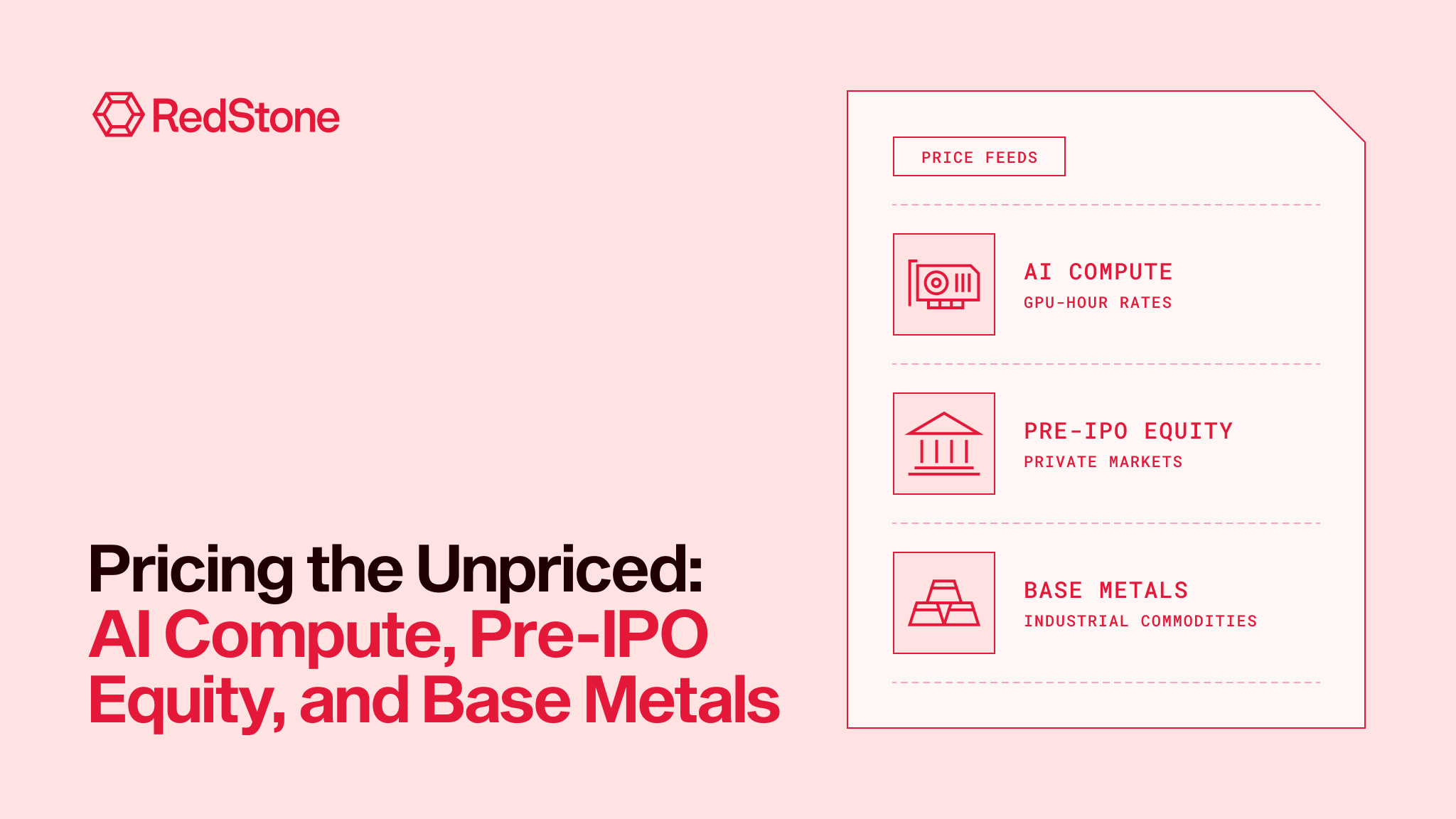
Pricing the Unpriced: Data Feeds for AI Compute, Pre-IPO Equity, and Base Metals
Table of Contents (21 sections)
- The Four Questions a Price Feed Runs on
- AI Compute: Two Indices, One GPU, Different Answers
- Where the Market Stands
- The Onchain Path
- Diverging References
- Volatility Is a Design Choice
- Manipulation and Basis
- What a Price Feed Has to Handle
- Pre-IPO Equity: When the Order Book Is the Oracle
- How the Market Got Here
- Why Backed Tokens Struggle
- Price Discovery Without an Anchor
- The Listing Transition
- Disclosure
- Base Metals: Proving the Metal Behind the Price
- The Price Is the Easier Part
- The Hard Part Is Attestation
- What a Data Infrastructure Has to Handle
- Side-by-Side Comparison
- FAQ
- About RedStone
A novel asset is hard to price onchain without liquid independent markets to use as a reference. In that situation, the price feed provider has to choose a source or build one.
GPU compute is listed onchain but thinly traded, while regulated compute futures wait on a CFTC review that runs to November 9. Pre-IPO perpetuals price Anthropic at roughly $2 trillion ahead of a listing that Reuters reports could follow the November midterms. And the London Metal Exchange is rewriting the rules behind the warrants that any tokenized base metal would rely on.
The Four Questions a Price Feed Runs on
Before exploring the specific assets, let’s start with a quick benchmark for what a price feed provider looks into when approaching a new asset. We will consider these for each of the novel RWAs in the spotlight.
- Reference market. Is there a market whose price can be trusted as the input?
- Source agreement. If several sources exist, do they agree? If not, which one should the price feed follow?
- Manipulation cost. How much would it cost someone to move the input price by enough to profit downstream?
- Transitions. What happens when the asset changes regime, such as a futures listing, an IPO, or a physical delivery?
AI Compute: Two Indices, One GPU, Different Answers
Where the Market Stands
Three regulated venues plan to list GPU compute futures, and each references a different index:
| Venue | Index provider | Status |
|---|---|---|
| CME (NYMEX) | Silicon Data H100 and B200 rental indices | Planned for October 5; CFTC review extended to November 9 |
| ICE | Ornn Compute Price Index (OCPI) | Announced May 2026, subject to regulatory approval |
| Nodal Exchange | Compute Desk | Announced September 2026 |
Sources: CME, ICE, Finance Magnates.
Architect has separately partnered with Ornn on exchange-traded perpetual futures for GPU and RAM pricing.
The CFTC’s Division of Market Oversight extended its review of the CME filings on September 21, citing “novel or complex issues.” Its public request for comment, which closed October 20, asked about the size and liquidity of the rental market, manipulation risk, customer protection, and perpetual compute futures.
The Onchain Path
Compute is already listed onchain, though barely traded. Lighter launched an H100 perpetual in May that settles against Ornn’s hourly H100 index, with up to 10x leverage. On October 23 it showed $253.87 of 24-hour volume, $9,630 of open interest and a 6.1% bid-ask spread. On Hyperliquid, at least two HIP-3 deployers have registered H100 markets: Paragon paid about $23,721 for the ticker in May. Neither had launched by late October, and Hyperliquid’s API shows them as delisted with no trading history, the default status for registered but inactive assets.
The policy push is coming from the same ecosystem. On October 20, the Hyperliquid Policy Center filed a comment letter asking the CFTC to allow US perpetuals and futures on GPU rental prices and AI inference costs. The letter argues that perpetuals suit an asset that cannot be stored: “A GPU-hour exists only in the hour it is used.” It asks the CFTC to allow competing benchmarks, and proposes safeguards including leverage limits, funding-rate caps, open-interest caps, position limits, independent price contributors and advance notice when an index shifts to newer chips.
Compute also reaches onchain markets as collateral. USD.AI makes loans secured by GPUs and had more than $225 million locked when Bullish extended it a $100 million facility on August 28. Falcon is structuring a tokenized GPU forward that finances hardware between payment and delivery. These products need a different input: the value of the hardware over time, which rental-rate indices only partly capture.
Diverging References
For a price data provider, the first problem is that the candidate reference indices measure different things. Ornn OCPI is a volume-weighted, winsorized average of transacted H100 SXM rental prices, settled daily at 4:00 PM ET. Silicon Data standardizes observations across neo-cloud providers and GPU marketplaces for machine specs, rental terms and location, then filters outliers.
On October 22, OCPI H100 printed $3.15 per GPU-hour and Silicon Data’s neo-cloud H100 index printed $2.88. And the difference goes beyond price levels: a working paper from HEC Montréal found that weekly changes in the two H100 indices correlated at 0.17 across their overlapping history, and 0.24 on a balanced 49-week sample. Silicon Data’s index was unchanged on 45.6% of days, against 19.4% for Ornn. Researchers at Johns Hopkins found that the two providers’ indices “tend to be separated,” and attributed the gap to index construction, market segment coverage or both.
Volatility Is a Design Choice
The two indices also pass through very different amounts of noise. Over the 92 days from July 23 to October 22, OCPI H100 ranged from $2.49 to $3.21. Its average daily move was 3.6%, it moved more than 5% on 22 of 91 days, and its largest single-day move was 13.5% (Ornn index history; RedStone calculation).
For a futures contract that settles monthly, daily noise matters less. For an onchain perpetual or a lending market that marks positions continuously, the oracle’s choice of index decides how much of that noise reaches liquidation logic. A transaction-based index reflects real trades and moves often. A smoothed observation index is calmer but updates less. Neither is wrong, but they suit different products, and a protocol should know which one it is integrating.
Manipulation and Basis
Compute indices draw on a small number of contributors, and some of those contributors may also hold positions. As Dave Friedman sets out, a contributor with a short futures position could post a lower quote. If that quote carries enough weight in settlement, the contributor profits. The cost of the attack depends on whether the quote is backed by real, bookable capacity. Standard mitigants include contributor weight caps, settlement windows, input audits and testing the index with its largest contributors removed.
Basis is the second issue. An hourly on-demand rental rate is a different product from a reserved cluster with networking and availability guarantees, even on identical chips. A hedge against one leaves exposure to the other.
What a Price Feed Has to Handle
- Source selection: a documented rule for which index, or which blend, is the reference.
- Divergence handling: what happens when sources disagree beyond a threshold.
- Futures-to-spot normalization: once listed futures trade, the oracle needs a rule for whether it references spot rental indices, the front-month future or a derived curve.
- Contributor transparency: visibility into who supplies the inputs and how concentrated they are.
Pre-IPO Equity: When the Order Book Is the Oracle
How the Market Got Here
Tokenized private equity grew 935% year on year, the fastest-growing RWA category, ahead of tokenized stocks at 395%. Most pre-IPO exposure trades as synthetic perpetual futures rather than tokens backed by shares. On September 28, equity perps on decentralized venues carried $3.3 billion of open interest, more than the entire $3.16 billion tokenized stock supply.
Anthropic is the largest live example. Its perp on Entropy implied a valuation of up to $2.3 trillion on September 9, against the $965 billion Series H. On September 1, CoinGecko tracked Anthropic perps on 19 venues, with implied valuations between $1.88 trillion and $1.99 trillion. Total open interest exceeded $100 million by late September, $36 million of it on Entropy’s Hyperliquid market.
Why Backed Tokens Struggle
Share-backed pre-IPO tokens face a problem that sits upstream of any price feed. When Robinhood issued OpenAI tokens backed by an SPV stake, OpenAI responded publicly: “These ‘OpenAI tokens’ are not OpenAI equity.” On May 12, 2026, Anthropic and OpenAI declared unapproved transfers of their private shares “null and void,” and PreStocks tokens for both companies fell about 35% within 24 hours. Ahead of the SpaceX IPO, xStocks could not source enough shares, and more than $1 billion of customer orders across Binance Wallet, Bybit and Bitget Wallet went largely unfilled.
For a backed token, the price feed question includes what the token actually holds. That is an attestation problem, and it returns in the base metals section below.
Price Discovery Without an Anchor
Perps are effective price-discovery tools when an external market eventually checks them. RedStone’s analysis of 449 trade.xyz market-weekends found that the Sunday 20:00 ET perp price called the direction of Monday’s open 65% of the time, 6.4 standard deviations above chance. A separate 0xArchive study found that using the last perp price instead of Friday’s close cut the average reopen error from 125.4 to 60.5 basis points.
Pre-IPO perps have no external market until listing day, and the error is an order of magnitude larger:
| Company | Final perp price | Nasdaq open | Perp vs open |
|---|---|---|---|
| Cerebras (CBRS) | $298.00 | $350.00 | -14.8% |
| Quantinuum (QNT) | $91.43 | $68.00 | +34.5% |
| SpaceX (SPCX) | $176.76 | $150.00 | +17.8% |
The mechanism explains the gap. On trade.xyz, the oracle uses external venue prices while those venues are open. When they close, it advances an exponentially weighted moving average of the perp’s own order book with a 30-minute time constant. For a pre-IPO company, every hour is off-hours. The market is largely pricing itself.
The cross-venue data is consistent with this. Most of the 19 Anthropic venues in CoinGecko’s September 1 snapshot clustered within about 0.5% of each other, while the highest quote came from a venue showing zero 24-hour volume. Tight agreement across venues with thin, shared liquidity can reflect venues referencing each other as much as independent discovery.
The Listing Transition
The highest-risk moment for a pre-IPO perp is the switch from implied valuation to share price. Contracts typically rebase using the official share count and move their reference to the listed stock automatically. The SpaceX perp closed 17.8% above the opening print, although the stock reached $185 by June 18. SPCX perp open interest on Hyperliquid was about $483 million on June 13.
A price feed supporting these markets needs explicit rules for the switch: which print becomes the first reference (opening auction, first trade or a time-weighted window), how the share count is sourced, and how funding and liquidations behave across the gap. Anthropic is likely to be the next test.
Disclosure
RedStone Live provides price data for Entropy’s pre-IPO and RWA markets on Hyperliquid, 11 live HIP-3 markets in total. During market hours it uses institutional data sources, and off-hours it uses alternative aggregation. For background on why HIP-3 deployers weigh oracle design heavily, see The $600M Warning: Why Felix Chose RedStone for HIP-3 Perp Markets.
Base Metals: Proving the Metal Behind the Price
The Price Is the Easier Part
Copper, aluminium, zinc and lead have deep, regulated reference markets. LME prices are liquid and widely referenced, so the first of the four questions has a good answer. LME trading does not run around the clock, so a 24/7 onchain market faces the same off-hours question as tokenized stocks. The established playbook from tokenized gold and silver applies, as in RedStone’s commodity pricing work with Temple Digital Group on Canton.
The Hard Part Is Attestation
A tokenized base metal is only as good as its claim on physical metal. For LME-deliverable metal, that claim is a warrant: a document of title to a specific lot in an LME-approved warehouse. LME warrants already transfer electronically through LMEsword. The supporting evidence of what the metal is, and where it came from, is still moving to digital form.
The LME’s July 31 decision notice sets the timeline. Warehouse companies must now submit metal report data when a warrant is issued, rather than on request or cancellation. Auditing of warehouse confidentiality procedures extends to all warehouse companies from January 1, 2027. From January 1, 2030, metal is eligible for warranting only with an electronic certificate of analysis and an indelible production cast reference. Indelible marking is under consultation for new primary aluminium, lead and zinc brands.
The LME also plans to introduce electronic copper options in Q1 2027.
What a Data Infrastructure Has to Handle
For base metals, the data infrastructure provider’s job splits in two. The price feed follows established commodity methodology, with an off-hours policy. The harder deliverable is a reserve attestation that ties each token to specific warrants: warrant identifiers, warehouse location, brand and certificate of analysis, updated when warrants are cancelled or moved. Until electronic certificates are standard in 2030, part of that evidence will come from documents that cannot be verified automatically. Any design should say plainly which fields are machine-verified and which rely on a custodian’s statement.
Side-by-Side Comparison
| AI compute | Pre-IPO equity | Base metals | |
|---|---|---|---|
| Reference market | Competing rental indices; early onchain perps thinly traded; regulated futures pending approval | None until listing; perps and secondary trades | LME, liquid during trading hours |
| Main failure mode | Source disagreement and contributor influence | Self-referential pricing on thin books | Unverified backing |
| Next transition | Listed futures (CFTC review to November 9) | IPO and switch to share price | Electronic certificates of analysis (2030) |
FAQ
What is an AI compute price feed?
An AI compute price feed delivers the price of GPU compute, usually a rental rate per GPU-hour, to a smart contract. It sources that price from compute indices such as Ornn’s OCPI or Silicon Data’s rental indices, and needs rules for choosing between them when they disagree.
How are GPU compute futures priced?
The planned CME, ICE and Nodal contracts are cash-settled against rental price indices. CME’s contracts reference Silicon Data’s H100 and B200 indices, ICE’s reference Ornn’s OCPI, and Nodal’s reference Compute Desk.
How do pre-IPO perpetuals get a price before an IPO?
With no listed stock to reference, pre-IPO perps track an implied valuation. In practice the perp’s own order book, often smoothed with a moving average, acts as the price reference. Last funding rounds and secondary trades serve as loose anchors.
What happens to a pre-IPO perp when the company lists?
The contract rebases using the official share count and switches its reference to the listed stock price. Any gap between the final perp price and the opening print settles at that point.
What are LME warrants, and can they be verified onchain?
An LME warrant is a document of title to a specific lot of metal in an LME-approved warehouse. Warrants transfer electronically through LMEsword, and supporting documentation is moving to electronic form by 2030, which makes onchain attestation more practical over time.
About RedStone
RedStone is the data layer for institutional DeFi, delivering secure, low-latency price feeds for digital assets, RWAs, stablecoins, LSTs, LRTs, and Bitcoin LSTs across 110+ chains. Trusted by 200+ clients, including Securitize, Morpho, Pendle, Spark, Ether.fi, Ethena, Lombard, Venus, and Compound, RedStone powers lending, stablecoins, perpetuals, and tokenized asset markets with custom pricing infrastructure built for complex onchain systems. RedStone provides data for tokenized products including BlackRock’s BUIDL, Apollo ACRED, and Hamilton Lane SCOPE. Zero mispricing events. 100% uptime. Learn more at redstone.finance.