The RedStone Podcast Ep4: Brickken on Tokenized Assets AI Can Actually Read
Table of Contents (5 sections)
Every week on The RedStone Podcast, we sit down with the people building institutional finance onchain for five minutes: long enough to take the industry’s pulse and hear what’s on the mind of the founders, asset managers, and market-infrastructure leaders that are building it.
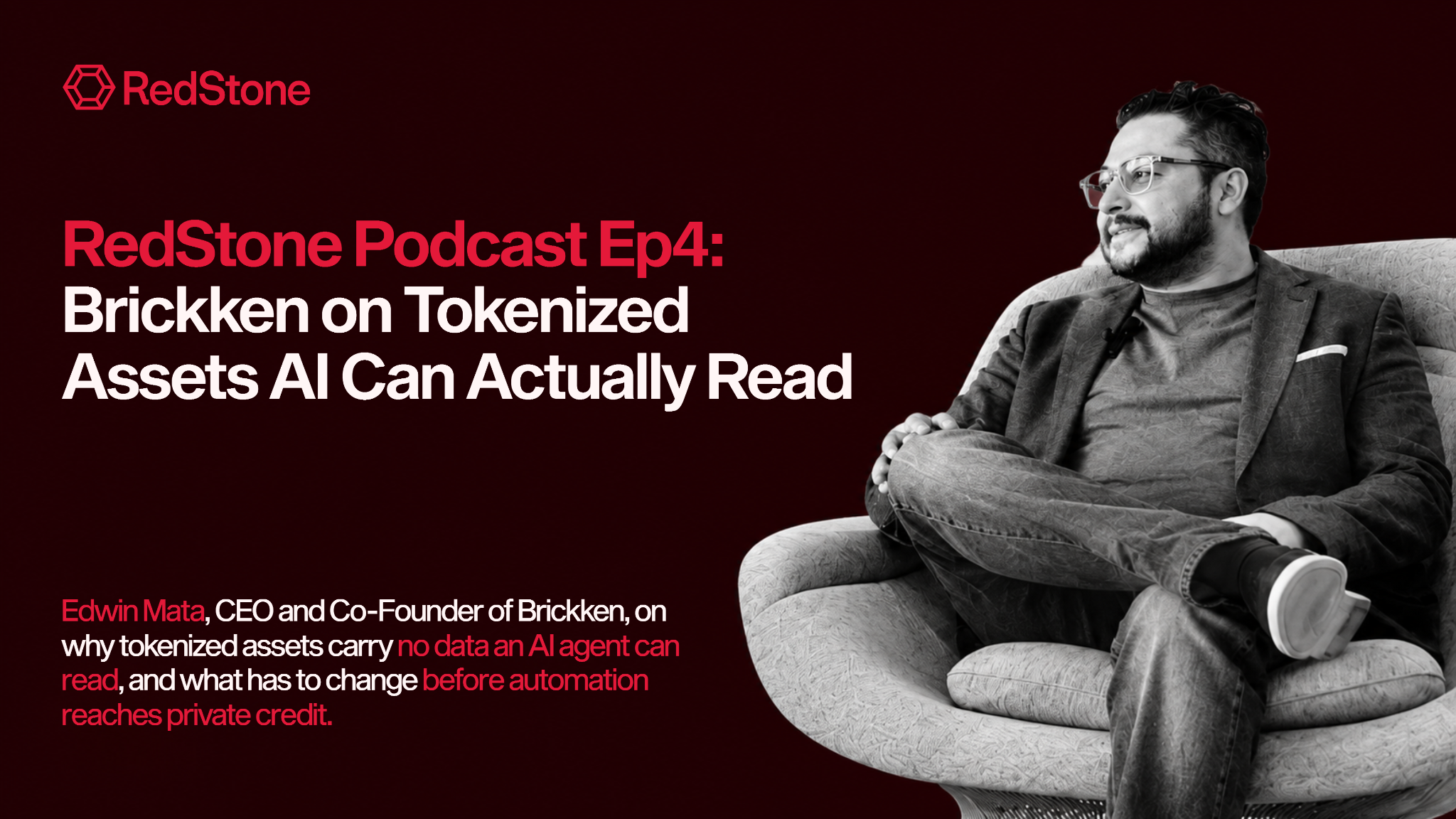
No long rants or forty-minute origin stories, no filler or padding. This week, Mike Massari, Head of Partnerships at RedStone, sits down with Edwin Mata, CEO and Co-Founder at Brickken.
Edwin Mata is the CEO and founder of Brickken, a tokenization platform that handles issuance and lifecycle management for asset issuers and regulated entities. He came to it from M&A law, after years of watching multi-million euro transactions run on paper trails and manual reconciliation.
Brickken has enabled the tokenization of more than $500 million in assets for over 150 clients across 30 countries, and its co-founder and Head of Blockchain, Dario Lo Buglio, authored ERC-7943, the open interface for compliant RWA tokens that reached Final status as an official Ethereum standard in May 2026. .
According to him, Wall Street will be running on blockchain technology by 2030. That’s only four years out, and his answer for what gets us there is narrower than the prediction: tokens an AI can actually read.
Brickken was developed with that future in mind. Its platform ships an API, an MCP server, and an SDK so agents can create tokenized instruments and trade them without a human in the loop. These agents, however, still can’t get the data they need to make decisions without resorting to third-party services offchain
The Product Information Is Still Offline
A tokenized asset is, for all intents and purposes, a transferable balance. The terms and the valuation of the underlying instrument, while sometimes referenced in transaction meta data, are stored offchain. The same goes for NFTs, that, while store data inside the toklen itself, still rely on external storage infrastructure. A human counterparty knows where to look. With software, that may not always be the case.
Brickken is working with RedStone and others on embedding product data in a form machines can read, so the instrument itself becomes legible. That covers the parts that don’t change: the terms, the structure, who is allowed to hold it. The parts that do change are a different job. A NAV is only useful if something keeps writing the current one onchain, and that is the gap RedStone fills for issuers on Brickken, alongside Credora risk ratings and T+0 settlement through RedStone Settle.
“The AI has to read offline data that is never updated online.”
What that opens up is less dramatic than the usual agent narrative. Edwin frames AI as a tool for the asset manager rather than a replacement for one. A good manager uses it to structure a product, put it in front of the market, and then hunt down the liquidity, which is the slow manual part of the job today.
The Windows Are Too Small
More than half a billion dollars tokenized is more thanb a rounding error. But how much of it is doing something relevant. His answer is about access points. Onchain liquidity still concentrates where the point of sale is, which means exchanges. Private credit is the part that stays stuck: the windows into it are narrow, the market is siloed, and finding a product means knowing someone.
“If I have a million and I want to invest in private credit, unless I call my bank or my broker, I don’t have access, or I don’t know where I can structure the product.”
Frequently Asked Questions
Why does tokenized asset data need to be machine readable?
A tokenized asset is usually just a token balance onchain, with the product details held offchain in documents and databases. A person can look those up. An automated system cannot, which means any agent acting on that asset is reasoning from data that was never designed for it. Making the product information readable onchain is what lets software price, compare, and transact those instruments without a human in the middle.
What did Edwin Mata say stablecoins have to do with tokenization?
He treats stablecoin adoption as the gating factor for everything else. Once banks and fintechs treat stablecoins as a standard form of currency, anything issued onchain becomes usable, because there is a settlement asset on the same rails. Until then, tokenized instruments sit next to a payment system they cannot reach.
How much has Brickken tokenized?
More than $660 million in tokenized value, across clients in over 30 countries. The platform covers issuance and ongoing management of instruments including equity, debt, private credit, bonds, and funds.
About RedStone
RedStone is the data layer for institutional onchain finance, delivering secure, low-latency price feeds for digital assets, RWAs, stablecoins, LSTs, LRTs, and Bitcoin LSTs across 110+ chains. Trusted by 200+ clients, including Securitize, Morpho, Pendle, Spark, Ether.fi, Ethena, Lombard, Venus, and Compound, RedStone powers lending, stablecoins, perpetuals, and tokenized asset markets with custom pricing infrastructure built for complex onchain systems. RedStone provides data for tokenized products including BlackRock’s BUIDL, Apollo ACRED, and Hamilton Lane SCOPE. Zero mispricing events. 100% uptime. Learn more at redstone.finance.
About Brickken
Brickken is an institutional-grade software provider enabling the compliant tokenization and management of real-world assets. Built for financial institutions, asset managers, and regulated entities, the platform digitizes financial instruments such as equity, debt, private credit, bonds, and funds, as well as tangible assets like real estate, infrastructure, and commodities. Brickken offers a complete solution to issue, manage, and operate tokenized assets through a single, secure platform.