The RedStone Podcast S2 Ep1: DogeOS on Turning Dogecoin into an Ecosystem
Table of Contents (13 sections)
- So Ridiculous It Might Work
- DogeOS Is More Than the Asset
- Built for the Web3 Curious
- About RedStone
- About DogeOS
- Frequently Asked Questions
- What is DogeOS?
- Why does Dogecoin need an app layer?
- How is DogeOS different from wrapped Doge on other chains?
- Who are DogeOS apps built for?
- Why does Jordan say builders should keep apps simple?
- Why does Jordan call Dogecoin the “blue chip meme”?
- What does RedStone do for DogeOS?
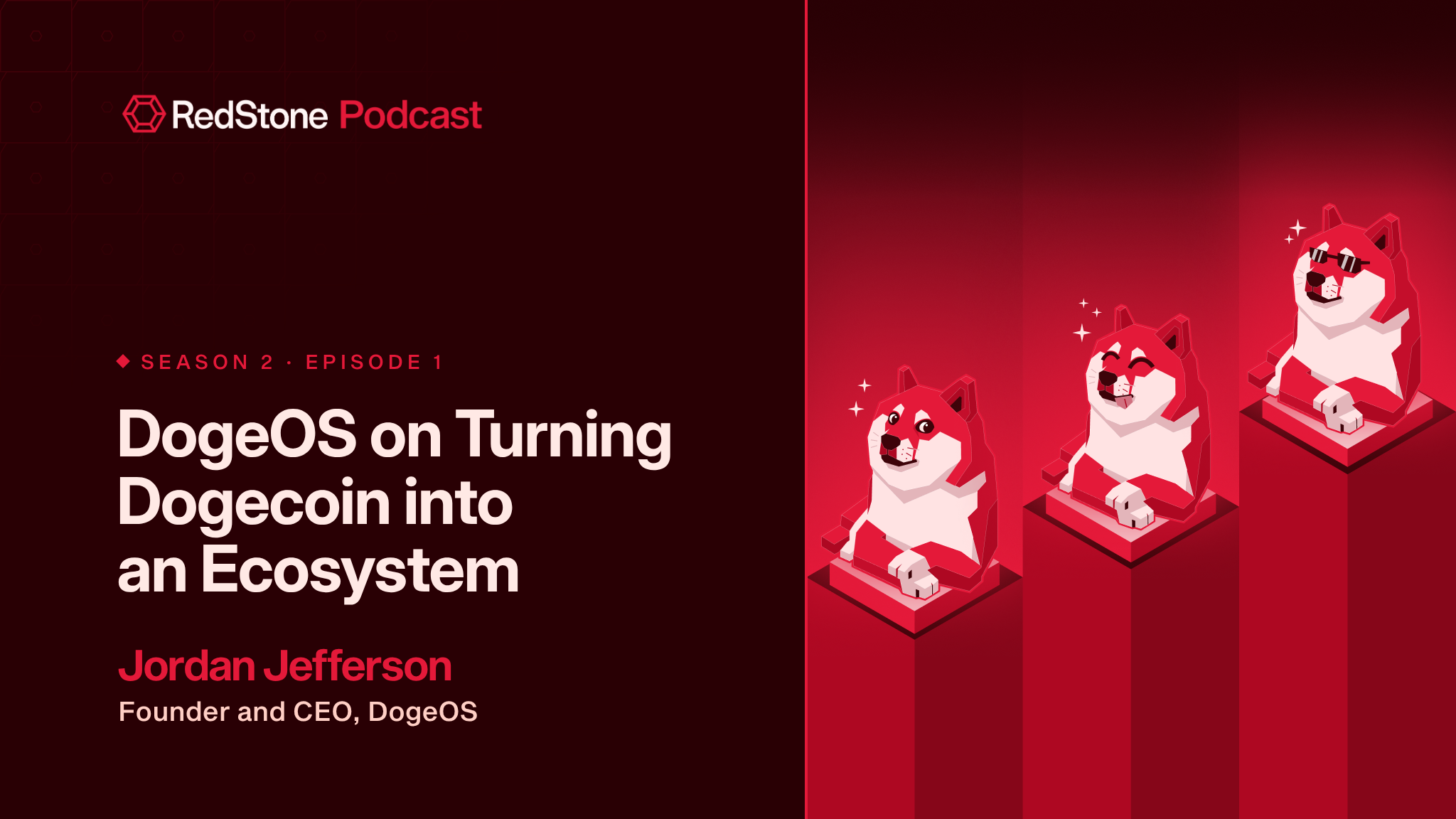
Every week on The RedStone Podcast, we sit down with a founder, an asset manager, or a market-infrastructure leader for a short, focused conversation about where onchain finance is going. This week, we’re happy to release the first episode of Season 2, recorded at TokenizeThis Singapore. Jordan Jefferson, Founder and CEO of DogeOS, joins Mike Massari, Head of Partnerships at RedStone.
The conversation follows the RedStone x DogeOS partnership announcement of 26 October 2026, in which RedStone’s oracle infrastructure came to DogeOS, with price feeds live on the DogeOS testnet.
Jordan Jefferson got into crypto in 2011. He went on to co-found the MyDoge wallet, which had more than half a million users as of May 2025. DogeOS is the app layer his team is building on that audience. Its public testnet opened on 30 September 2026.
So Ridiculous It Might Work
Jordan says DogeOS did not time its launch to the market. The team has been building in the Dogecoin space for years, and the timing happens to be ideal. After a bearish lull, the market has energy again: a recent chain launch showed that new projects can succeed, and people are looking for what comes next. Dogecoin has also had time to prove itself. After more than a decade, and with almost every other meme coin gone, Jordan calls it “clearly the blue chip meme”, which is why more people now take it seriously when he says DogeOS is turning Dogecoin into an ecosystem.
“Dogecoin is a joke, and we’re trying to build serious infrastructure together, but it’s so ridiculous, it might work.”
DogeOS Is More Than the Asset
Wrapped DOGE already exists on other chains, issued in custodied form by Coinbase and Binance. What is missing, Jordan says, is a decentralized, permissionless cross-chain Doge standard, and DogeOS is building one. He sees that as the smaller part of the plan.
“The vision is that Dogecoin itself, the original meme chain, the second biggest proof of work blockchain in the world, can actually support a whole ecosystem. It’s more than just the token. It’s more than just the asset.”
An ecosystem of lending markets, perps and stablecoins runs on price data, and RedStone supplies it for applications built on DogeOS, with price feeds live on the testnet. DogeOS starts with an audience already in place, the MyDoge user base. For RedStone, the integration reaches an ecosystem built around what Jordan calls a massive retail audience that has not yet used Web3.
Built for the Web3 Curious
Jordan says Dogecoin had no smart contracts until now, so much of its large retail audience has never used Web3. He sees a fresh slate, and a constraint. A trading tool on another chain can shrug off a confused newcomer. On Dogecoin, a builder who ignores newcomers will not reach much of the community.
“I think the big opportunity on Dogecoin is building things that this retail audience who’s Web3 curious can actually understand and get behind.”
That is why the DogeOS team pushes outside builders toward simpler interfaces. Years of supporting MyDoge users showed Jordan how hard self-custody is for most people, and he puts the burden on the builder.
“No matter how much you explain something, maybe it’s actually on us to innovate a little and make it absolutely bulletproof.”
Hear how DogeOS plans to build for Dogecoin’s retail audience in the full episode on YouTube.
About RedStone
RedStone is the data layer for institutional onchain finance, delivering secure, low-latency price feeds for digital assets, RWAs, stablecoins, LSTs, LRTs, and Bitcoin LSTs across 110+ chains. Trusted by 200+ clients, including Securitize, Morpho, Pendle, Spark, Ether.fi, Ethena, Lombard, Venus, and Compound, RedStone powers lending, stablecoins, perpetuals, and tokenized asset markets with custom pricing infrastructure built for complex onchain systems. RedStone provides data for tokenized products including BlackRock’s BUIDL, Apollo ACRED, and Hamilton Lane SCOPE. Zero mispricing events. 100% uptime. Learn more at redstone.finance.
About DogeOS
DogeOS is the App Layer for Dogecoin, where community, culture, and liquidity come together to power the next generation of consumer apps. Founded by the team behind MyDoge, the #1 Dogecoin wallet, DogeOS champions Dogecoin as the people’s currency by empowering developers to build experiences in gaming, DeFi, AI, and more, all backed by the world’s most iconic crypto brand.
Frequently Asked Questions
What is DogeOS?
DogeOS is the app layer for Dogecoin, built by the team behind the MyDoge wallet. It brings smart contracts and apps to Dogecoin. Its public testnet opened on 30 September 2026, and no mainnet date has been announced.
Why does Dogecoin need an app layer?
Dogecoin had no smart contracts until now, so DOGE holders had nowhere to use it in apps or DeFi without moving to another chain. Jordan says DogeOS is about using Doge in DeFi, smart contracts and apps, and building an ecosystem around Dogecoin’s community and its proof of work chain.
How is DogeOS different from wrapped Doge on other chains?
Wrapped Doge on other chains is a custodied version of the asset, issued by exchanges such as Coinbase and Binance. Jordan describes DogeOS as building a decentralized, permissionless cross-chain Doge standard, plus a full ecosystem around Dogecoin rather than only moving the asset.
Who are DogeOS apps built for?
Mainly for Dogecoin’s large retail audience, much of which has never used Web3. Jordan sees that as a fresh slate: newcomers who are curious about Web3 but are not used to how Solana, Ethereum or Base work. He says builders can set a new culture instead of copying what works elsewhere.
Why does Jordan say builders should keep apps simple?
Years of supporting MyDoge users showed him how hard self-custody is for most people. He puts the burden on the builder: no matter how much you explain something, it is on builders to innovate and make it “absolutely bulletproof”.
Why does Jordan call Dogecoin the “blue chip meme”?
He points to its longevity. After more than a decade, and with almost every other meme coin gone, he says Dogecoin has earned that status. He says it makes people easier to convince that Dogecoin can support an ecosystem.
What does RedStone do for DogeOS?
RedStone’s oracle infrastructure is integrated with DogeOS, as announced on 26 October 2026. Price feeds are live on the DogeOS testnet and supply the price data that lending markets, perps and stablecoins depend on. The announcement post has the details.