From Usable to Used: What It Takes to Put Stellar’s Tokenized Assets to Work
Table of Contents (12 sections)
- Stellar’s Tokenized Assets Are Going to Work
- A Repo That Rolled Through the Weekend
- What Arrived at Meridian
- The Institutional Pipeline: DTCC, Morgan Stanley and Bell
- The Collateral Ladder
- Two Requirements for Collateral That Gets Used
- A Price for Every Hour
- An Exit as Fast as the Loan
- Where RedStone Fits on Stellar
- What Comes Next
- About RedStone
- Frequently Asked Questions
Stellar’s Tokenized Assets Are Going to Work
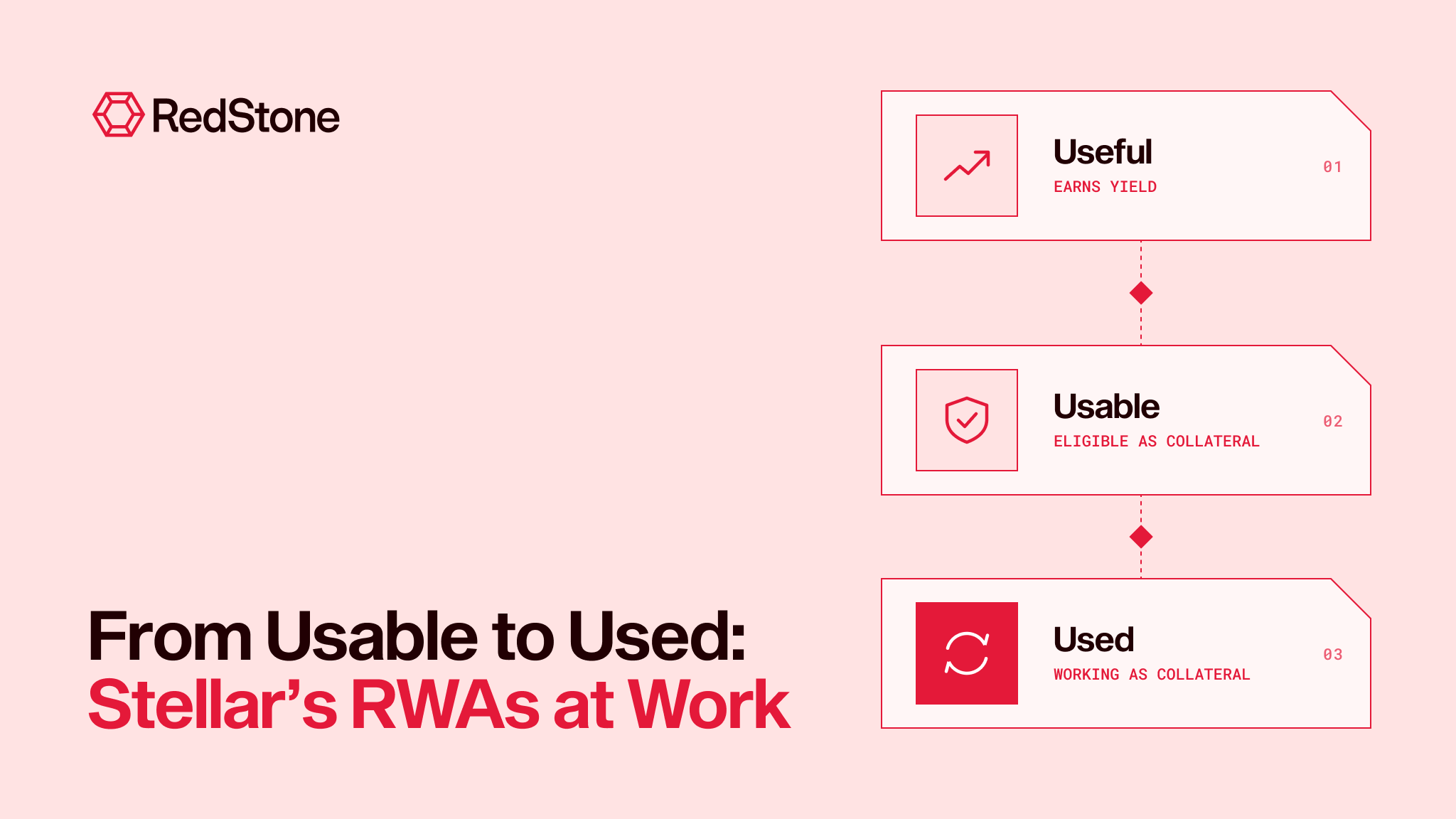
At Meridian 2026 in Lisbon, Stellar Development Foundation CEO Denelle Dixon described three stages for a tokenized asset. It can be useful, meaning it earns yield. It can be usable, meaning it is eligible as collateral. Or it can be used, meaning it is functioning as collateral in repo, lending and margin.
Stellar’s RWA sector totals about $4.5B, as per rwa.xyz, hitting that mark from $785M at the start of the year. Most of that already qualifies as useful. The next stage will be harder to measure in dollars, though; instead, it will show up in transactions. Some of those transactions came into the spotlight right around the Meridian, revealing what this transition will demand from its supporting infrastructure.
A Repo That Rolled Through the Weekend
In October, Ascend Markets and M1X Global completed what the parties described as the first institutional repo on Stellar. The collateral was USDM1, a dollar-denominated sovereign bond issued onchain by the Republic of the Marshall Islands and backed one-to-one by short-duration US Treasuries held by a trustee under New York law.
The agreement completed 72 consecutive hourly rolls between October 16 and 19, run programmatically through Ascend’s credit facility and Stellar smart contracts, with no manual intervention. It was priced at SOFR plus 10 basis points, an annualized 3.98%, with a 2% haircut and a maximum loan-to-value ratio of 98%. The repo closed with repayment and the return of the collateral.
M1X Global president Jordan Goldman noted at Meridian that traditional repo takes 24 to 48 hours to settle, and most of that market stops for the weekend. This one kept rolling through Saturday and Sunday.
Treasury-backed collateral was a natural place to prove the model. Its value moves very little over a weekend, and USDM1’s published par redemption schedule gave the parties a clear reference point for valuing it while the Treasury market was closed. That combination made the 2% haircut a reasonable fit for the risk being financed.
What Arrived at Meridian
The annual conference added several assets and structures that extend Stellar’s collateral base in different directions:
| Announcement | What it is | Status |
|---|---|---|
| Pontoro and Archax Automated Liquidity Pool | A pool pairing tokenized money market assets with private-market fund interests, issued by Archax as permissioned tokens | First live pilot, launched October 28 |
| Figure YLDS | An SEC-registered yield-bearing security that moves like a stablecoin, with yield accrued daily and paid monthly | Live on Stellar since May |
| Etherfuse stablebonds | Tokens backed by local government debt, such as Mexican CETES held at BBVA | About $50M a month moving through the platform |
| Janus Henderson and Centrifuge JQQQ | A Nasdaq-100 tracking fund for non-US professional investors, with Stellar as its only launch chain | Announced; subscriptions not yet open |
| Securitize | Stellar added to its supported networks, alongside Ethereum, Solana and Avalanche | First Stellar asset not yet named |
| Archax €GOVY | A euro version of Archax’s perpetual tokenized T-bill product | Announced |
Sources: Tearsheet, Tearsheet, Stellar.
The Pontoro pool deserves a closer look because it targets the least liquid end of the market. Selling a private fund interest before the fund returns capital usually means a slow, negotiated secondary sale. The pool holds a cash sleeve of money market assets alongside a sleeve of private fund interests, and it can buy interests from investors who want to exit early. The discount it requires on those purchases widens as the cash share falls and narrows as liquidity is replenished, while the fund manager keeps control of asset valuation. Withdrawals from the pool are paid from the cash sleeve first. It is an early pilot, but it applies a clear set of rules to a problem private markets have handled mostly through gates and waiting periods.
The Institutional Pipeline: DTCC, Morgan Stanley and Bell
The largest shift in Stellar’s collateral base is still ahead. DTCC’s Tokenization Service went live on October 28 with about 20 participating institutions, including JPMorgan, Citi, Bank of America, State Street and Morgan Stanley. On November 3, Morgan Stanley said it had begun converting US equities and Treasuries into tokenized form through the service. According to DTCC, the tokenized securities “retain the same economic entitlements, ownership rights and investor protections” as their conventional counterparts. Earlier production transactions on the service included securities lending, collateral transfers and Treasury repo.
The service runs on Canton and a private Besu network for now. At Meridian, Dixon said DTC’s tokenization service is expected to connect to Stellar in the first half of 2027. When it does, Stellar can gain access to the same tokenized equities and Treasuries that the largest US custodians are already using.
The near-term calendar is quite clear. The first milestone has already passed: Stellar validators approved the Bell upgrade (Protocol 30), which went live on mainnet on November 23. Among its changes, it lets a single smart contract hold balances for many customers through addresses that carry a customer identifier, a feature aimed at custodians and exchanges. It also records ledger close times in milliseconds, which leaves room for faster intervals in future upgrades.
The Collateral Ladder
Each new asset class brings a different relationship between the trading hours of the underlying assets and the token’s capability to work as collateral. Hourly repo and continuous lending markets run every hour of the week. The assets backing them mostly do not.
| Asset class | Stellar examples | When the underlying trades | Off-hours pricing | Exits |
|---|---|---|---|---|
| Treasury-backed instruments | USDM1, Franklin Templeton BENJI, Ondo USDY | US market hours, weekdays | Values move little and follow a NAV or par schedule | Redemption close to par |
| Local-currency government debt | Etherfuse CETES and TESOURO stablebonds | Local bond and FX market hours, weekdays | Rates and exchange rates can both move between Friday’s close and Monday’s open | Redemption depends on the local market |
| Equity trackers and tokenized equities | JQQQ (announced), DTC-tokenized equities (expected 2027) | US exchange hours, weekdays | No exchange price from Friday’s close to Monday’s open | Depth of the market when it reopens |
| Private credit and private funds | Interests in the Pontoro and Archax pool | Rarely; values come from periodic NAV | Value between NAV dates | Redemption windows, gates and queues |
As we move down the table, continuous valuation and fast redemptions grow progressively more challenging. For Treasury-backed instruments, off-hour pricing and redemption speed are enough for the October repo to work at a 2% haircut. For a tokenized equity on a Sunday, or a private credit interest between monthly or quarterly valuations, the picture is different.
Two Requirements for Collateral That Gets Used
A Price for Every Hour
A lending market or repo facility needs a collateral value whenever it checks a position. On Stellar, the SEP-40 standard already gives smart contracts a common way to read price data, including timestamps that let a protocol reject stale values. Our August report covers how the standard works.
The interface is in place. The harder part is the method behind the number. A stablebond backed by Mexican government debt needs both a local rate and an exchange rate, and neither market trades over a weekend. A tokenized equity needs a defensible reference when its exchange is closed. A private fund interest needs a view of value between NAV dates. Each of these calls for a pricing methodology suited to the asset, clear rules for how fresh a value must be, and haircuts sized to the largest gap a lender can reasonably expect.
An Exit as Fast as the Loan
A price tells a lender when a position needs to be closed, but the lender also needs a way to close it. Crypto-native collateral can usually be sold on an exchange within seconds. Many tokenized funds can only be redeemed through the issuer, with redemption windows that can run from 60 to 180 days, and only a limited set of verified parties may be allowed to hold the asset. An hourly repo and a quarterly redemption window do not line up.
One way to close that gap, now being explored across the industry, is to separate the liquidation from the redemption. When a lending position falls below its threshold, buyers who are already cleared to hold the asset take over the collateral, and the lender is repaid in the same transaction. The buyer then waits out the redemption period. Grayscale discussed the broader problem in our podcast episode on the redemption gap.
Pricing and settlement work together. A precise price without a fast exit leaves a lender holding collateral it cannot sell. A fast exit without a reliable price gives the auction nothing to anchor to.
Where RedStone Fits on Stellar
RedStone launched oracle infrastructure on Stellar in March 2026 and has since adopted the SEP-40 standard. As of November 6, RedStone provided 65 price feeds on Stellar, covering assets including Ondo’s USDY, Franklin Templeton’s BENJI and iBENJI, Etherfuse stablebonds, Centrifuge deRWA tokens and Paxos PYUSD. On the exit side, RedStone Settle is RedStone’s liquidity infrastructure for tokenized assets, built to give holders an exit path beyond the standard redemption cycle. It launches first on Ethereum.
“Stellar has already run repo through a weekend. Most of the assets that could back it still don’t trade on Sundays. Closing that gap, asset class by asset class, is how tokenized collateral scales.”
Matt Gurbiel, Vice President.
What Comes Next
The near-term calendar is quite clear. The Bell upgrade has been live on mainnet since November 23. DTC’s tokenization service is expected to connect to Stellar in the first half of 2027, and Morgan Stanley plans to support tokenized equity trading through its alternative trading system starting in the first quarter of 2027.
Between now and then, the October repo is a useful benchmark. It showed that a Stellar-based financing transaction can run around the clock with no manual steps. Extending that to local-currency debt, equities and private credit will depend on pricing each asset for every hour it is used, and on settlement that lets a lender exit as quickly as the loan requires. Those are the conditions for moving Stellar’s real-world assets from usable to used.
About RedStone
RedStone is the data layer for institutional DeFi, delivering secure, low-latency price feeds for digital assets, RWAs, stablecoins, LSTs, LRTs, and Bitcoin LSTs across 110+ chains. Trusted by 200+ clients, including Securitize, Morpho, Pendle, Spark, Ether.fi, Ethena, Lombard, Venus, and Compound, RedStone powers lending, stablecoins, perpetuals, and tokenized asset markets with custom pricing infrastructure built for complex onchain systems. RedStone provides data for tokenized products including BlackRock’s BUIDL, Apollo ACRED, and Hamilton Lane SCOPE. Zero mispricing events. 100% uptime. Learn more at redstone.finance.
Frequently Asked Questions
Can tokenized assets on Stellar be used as collateral today?
Yes. In October, Ascend Markets and M1X Global completed a repo on Stellar using USDM1, a tokenized sovereign bond backed by US Treasuries, as collateral. Lending protocols on Stellar such as Blend also support collateral priced through SEP-40 feeds.
How are real-world assets priced on weekends?
It depends on the asset. Treasury-backed funds can be valued from their NAV or redemption schedule, since their value moves very little. Assets such as local-currency government debt, equities and private credit need asset-specific methods to produce a defensible value while their underlying markets are closed, along with rules for how fresh that value must be.
What is SEP-40?
SEP-40 is a Stellar standard that defines how Soroban smart contracts read price data from oracles. It gives protocols one interface for consuming feeds from any compliant provider, including timestamps for checking staleness.
What happens when collateral has a long redemption window?
A lender cannot wait 60 to 180 days to recover cash from a defaulted position. One emerging approach is to have pre-vetted buyers take over the collateral and repay the lender immediately, while the buyer waits out the redemption period.
When will DTCC-tokenized securities reach Stellar?
DTCC’s Tokenization Service launched on October 28, 2026, on Canton and a private Besu network. According to the Stellar Development Foundation, its connection to Stellar is expected in the first half of 2027.