The DeFi Distribution Playbook for RWA Issuers: A Step-by-Step Guide to RWA DeFi Integration
Table of Contents (12 sections)
- Written by Krzysztof Gogol, PhD
- Why RWA DeFi Integration Needs a Plan
- Inside the Playbook
- NAV Onchain: Machine-Readable and Verifiable
- Liquidity Ahead of Redemption: Getting to Cash Before the Redemption Window
- RWA Risk Ratings: Measuring the Chance of Loss Before Capital Moves
- A Live Integration: Obligate’s oTFY on Solana and Ethereum
- What This Opens Up for Issuers
- Frequently Asked Questions
- About Krzysztof Gogol, PhD
- About RedStone
- Download the Full Playbook

Issuers taking a tokenized asset into DeFi now have a step-by-step route to follow, from token design to a working lending market and an exit inside the redemption window, with indicative costs at each stage. The DeFi Distribution Playbook for RWA Issuers is available today as a free PDF.
RedStone research from October 2026 puts the onchain real-world asset (RWA) market above $38 billion, with 11% of that value integrated into decentralized finance (DeFi) markets. The playbook notes that the tokenized RWAs that scaled successfully through DeFi share similar patterns: an evergreen token that accrues value in NAV, and deep secondary liquidity that offers fast exits beyond traditional redemption terms.
Written by Krzysztof Gogol, PhD
Krzysztof Gogol, PhD, advises issuers, allocators and lending-market curators on RWA structuring, DeFi distribution, vault design and independent risk assessment. He advised on the DeFi integration of Obligate’s oTFY, has worked with Project Guardian and financial regulators, and holds a PhD from the University of Zurich, where his research covered scaling decentralized finance with layer-2 blockchains. He is a strategic advisor to Obligate and Nook.
The playbook is Krzysztof’s work, written in collaboration with RedStone, which contributed the sections on liquidity ahead of redemption and risk ratings.

Why RWA DeFi Integration Needs a Plan
A tokenized fund still carries the terms of the fund behind it: subscription and redemption windows and a minimum ticket size. DeFi adds distribution layers on top. Holders can borrow against the token without selling it, investors can trade it onchain outside the issuer’s primary process, and DeFi-native lenders and allocators can reach the asset beyond the issuer’s existing channels.
None of that happens by itself. The playbook describes a flywheel in which a token accepted as collateral draws borrowers, borrowers draw lender liquidity, and part of that liquidity flows into secondary markets that make the token more attractive to hold. A listing with no lender liquidity behind it does not let anyone borrow. A token with no secondary depth leaves borrowers without a clean way out of a position. An issuer pursues two outcomes in DeFi: a lending market that finances its investors, and a secondary market where investors buy and sell the token 24/7 at any size. A NAV oracle and liquidity ahead of redemption are the enablers for achieving these goals.
Inside the Playbook
The chapters follow the order in which an issuer meets each decision: the liquidity flywheel, token design decisions, accessing DeFi lending markets (curator due diligence, risk ratings and monitoring, NAV onchain through oracle infrastructure, liquidity ahead of redemption, and first borrowers and lenders), establishing the secondary market, growing the market, what an RWA-to-DeFi launch costs, a case study on Obligate’s oTFY on Solana and Ethereum, a leadership readiness checklist and conclusions.
The cost chapter puts an indicative range on each line item, from low-to-mid five figures for smart contract or wrapper development to low tens of thousands up to six figures for oracle setup. Market-making liquidity and lender liquidity are the largest and most variable lines. The checklist at the end shows how far a structure is from ready.
NAV Onchain: Machine-Readable and Verifiable
An oracle can only feed what it can read. A NAV published as a PDF once a month is not usable by DeFi infrastructure, while a NAV available through a machine-readable API at a known update frequency is the baseline for any oracle integration.
When the NAV comes from a single fund administrator, its provenance matters as much as its delivery. RedStone and Securitize created a standard for this, the Trusted Single Source Oracle (TSSO). Each NAV update is digitally signed and timestamped at the source and linked to the previous update, so a lending market can verify that the onchain number is the one the fund published. As of August 2026, Securitize holds about 18% of the $16.2 billion tokenized US Treasury fund market.
Liquidity Ahead of Redemption: Getting to Cash Before the Redemption Window
Most RWA exits stall at the redemption window. A token can trade onchain around the clock and still redeem on T+1, T+3, T+30 or T+90. Secondary depth helps, but it carries inventory costs and thins out when a large exit or a liquidation arrives.
The playbook covers three ways out that work inside the window without changing the fund’s terms. With instant redemption, a holder swaps the token for stablecoins and skips the redemption queue. Instant liquidation sells the collateral and repays the debt in one transaction, so the lending market does not need a liquidator willing to wait out a redemption cycle. Atomic deleveraging unwinds a looped position in one action, which lets a borrower cut risk before a liquidation forces the issue. When a curator weighs whether to list a token, and at which loan-to-value ratio, the exit route often decides it.
The issuer keeps control of the terms. It sets a discount floor for each asset, bidding on permissioned tokens can be limited to liquidity providers that passed KYB and KYC checks, and the subscription, redemption and transfer-agent processes stay as they are.
RedStone Settle is the example the playbook uses. When a holder or a lending market needs out, KYB-verified solvers bid a discount to the asset’s value. The winning bid settles atomically onchain, in the same transaction as the price update, so nobody can front-run it. The solver then redeems through the issuer’s normal channel, keeping its capital offchain until it is needed, and RedStone runs the auction without holding the assets. Settle needs a RedStone price feed for the asset and no technical work from the issuer or the curator. For crypto-native collateral, RedStone Atom does a similar job with Oracle Extractable Value (OEV) capture and sub-300 ms liquidations.
RWA Risk Ratings: Measuring the Chance of Loss Before Capital Moves
A liquidation plan sets the procedure after a position fails. A risk rating estimates how likely that is before anyone commits capital, and monitoring shows when the estimate moves.
What a rating is for depends on who reads it. Issuers get an independent reference point that curators and lenders share, so each venue does not start its review from zero, plus an early look at structural gaps before a curator’s risk committee finds them. Lenders and allocators can weigh yield against the probability of losing principal instead of reading the stated rate alone. Curators use ratings to choose acceptable collateral and loan-to-value parameters, and monitoring tells them when a parameter has to change.
Credora, the risk intelligence layer of the RedStone platform, is the playbook’s example. It provides simulation-based risk ratings that quantify the probability of principal loss in DeFi vaults and assets, and it monitors the credit quality of underlying portfolios as conditions change. The ratings are published onchain and used on Morpho and Spark. Curators use them for due diligence when they list a new RWA, and liquidity providers use them to analyze an asset before bidding in a Settle auction.
A Live Integration: Obligate’s oTFY on Solana and Ethereum
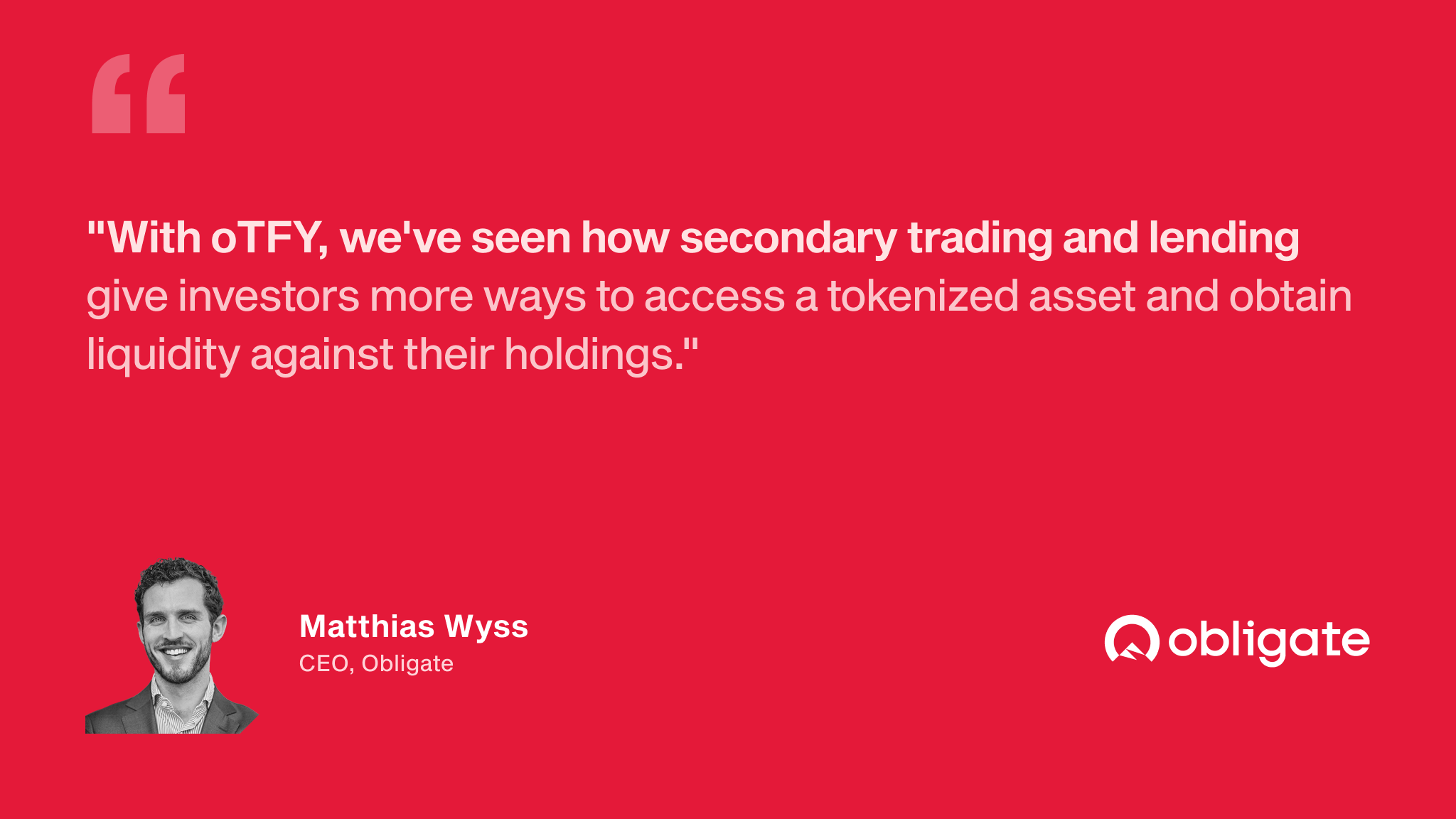
A case study in the playbook shows the route in practice. Obligate’s oTFY is an evergreen token backed by a revolving trade-finance portfolio. As of October 2026 it had a market capitalization of about $30 million, with 40% allocated to DeFi: $7.18 million used as collateral on Kamino, which works out to 2.7x aggregate oTFY exposure per $1 of net investor equity, and $3 million on Morpho.
Three connected markets carry it. Eligible investors subscribe and redeem with Obligate at NAV, with a $100,000 minimum. Traders buy and sell oTFY at market price on Uniswap and Raydium, 24/7, as an alternative to primary subscriptions and redemptions. On Kamino and Morpho, investors post oTFY as collateral to borrow USDC without selling, while USDC depositors such as neobanks supply the liquidity and earn roughly 150 to 200 basis points below the oTFY yield. The Morpho oTFY markets on Ethereum went live on 22 October 2026 and use a RedStone oracle to bring NAV onchain for collateral valuations.
Disclosure: Krzysztof is a strategic DeFi advisor to Obligate and helped structure the lending integration described in the case study.
What This Opens Up for Issuers
Issuers can see the whole route before their first curator call. Curators and allocators run the same analysis from the other side, and the playbook gives both a shared reference for what a DeFi-ready structure looks like. The market data shows the room: 11% of an onchain RWA market above $38 billion is integrated into DeFi, while the playbook reports that over 30% of tokenized private credit RWAs already benefit from DeFi integration. RedStone provides data for tokenized products including BlackRock’s BUIDL, Apollo ACRED and Hamilton Lane SCOPE.

Frequently Asked Questions
What is the DeFi Distribution Playbook for RWA Issuers?
A practical guide for issuers taking a tokenized asset into DeFi, written by Krzysztof Gogol, PhD, in collaboration with RedStone. It runs from token design to a working lending market, secondary liquidity, oracles and liquidity ahead of redemption, with indicative costs, a case study and a launch checklist. It is a free PDF.
Who is the playbook for?
Business development and product teams at asset issuers and tokenization platforms planning an RWA DeFi integration. Curators and allocators reviewing an RWA as collateral will recognize the same questions from the other side.
What does an RWA issuer need before launching in DeFi?
The playbook’s checklist has twelve items, from a finished token design and a lending venue to a machine-readable NAV feed, a market maker with primary-market access and a risk rating.
How much does it cost to bring an RWA into DeFi?
The playbook gives indicative ranges per line item: low-to-mid five figures for smart contract or wrapper development, mid five figures and up for an audit, and low tens of thousands to six figures for oracle setup. A market maker runs about a $10K monthly retainer plus 10 to 25% on deployed capital at smaller size. Market-making liquidity and lender liquidity are the largest and most variable lines.
How can RWA holders exit before the redemption window opens?
Through secondary liquidity backed by a market maker with primary-market access, or through a settlement layer. In a settlement layer, liquidity providers buy the token at a discount to its fair value, pay out stablecoins at once and redeem through the issuer’s usual process. RedStone Settle runs this as an auction among KYB-verified solvers, and the same route handles RWA liquidations and the unwinding of looped positions.
Why do RWA issuers need risk ratings?
A rating gives curators and lenders a shared, independent view of how likely a loss of principal is before they commit capital, and monitoring shows when that view changes. For the issuer, it avoids a fresh review from scratch at each venue and shows where the structure is weakest before a risk committee finds out.
About Krzysztof Gogol, PhD
Krzysztof Gogol, PhD, is a DeFi advisor working with RWA issuers, allocators and lending-market curators. He holds a PhD from the University of Zurich and is a strategic advisor to Obligate and Nook. He offers short readiness reviews for issuers preparing a DeFi launch, and due-diligence support for allocators. X: x.com/krzysgogol | LinkedIn: linkedin.com/in/krzysztofgogol
About RedStone
RedStone is the data layer for institutional DeFi, delivering secure, low-latency price feeds for digital assets, RWAs, stablecoins, LSTs, LRTs, and Bitcoin LSTs across 110+ chains. Trusted by 200+ clients, including Securitize, Morpho, Pendle, Spark, Ether.fi, Ethena, Lombard, Venus, and Compound, RedStone powers lending, stablecoins, perpetuals, and tokenized asset markets with custom pricing infrastructure built for complex onchain systems. RedStone provides data for tokenized products including BlackRock’s BUIDL, Apollo ACRED, and Hamilton Lane SCOPE. Zero mispricing events. 100% uptime. Learn more at redstone.finance.
Download the Full Playbook
Share the full DeFi Distribution Playbook for RWA Issuers with your team: download the PDF.
Bringing a tokenized fund into DeFi? Talk to the RedStone team: redstone.finance/institutional