The Seoul Standard: A joint report by RedStone and Kaia
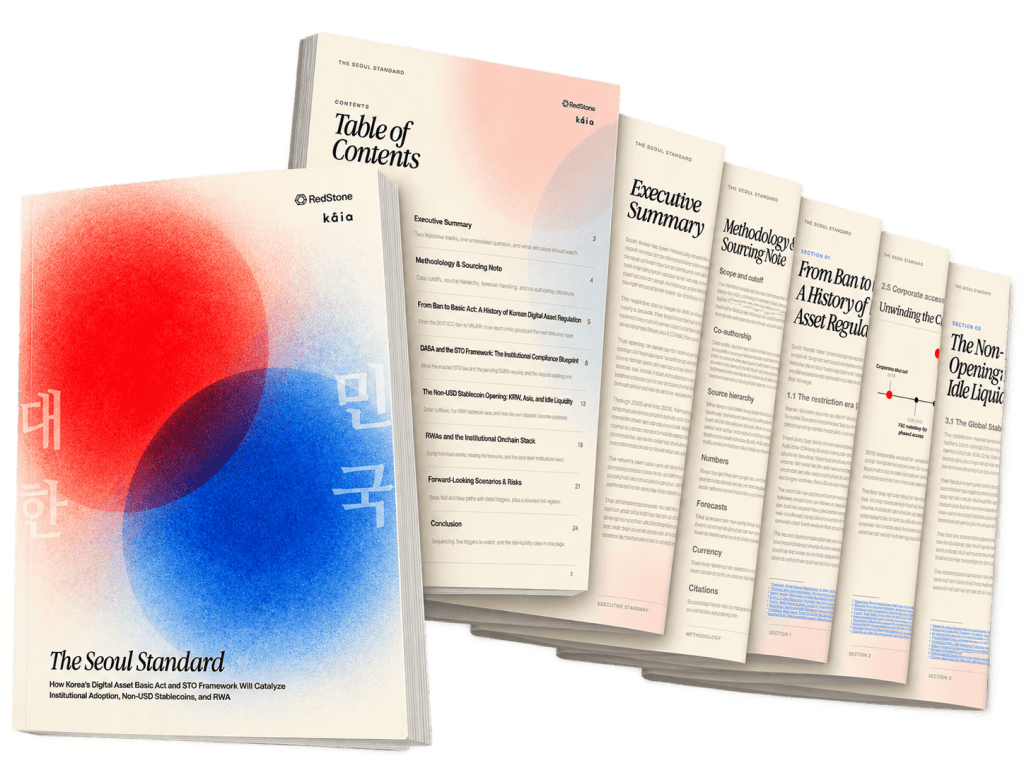
Table of Contents (3 sections)
The Gap Between Korea’s Liquidity and Its Law
The KoreaThe Korean won is the second most traded currency in the digital asset space, behind only the dollar and its stablecoins. KRW pairs account for roughly 30% of global spot volume.
None of that liquidity can work as collateral onchain. There is no legally recognized won stablecoin to settle in, and using a dollar stablecoin means converting out of won first. Korea has the native liquidity and no domestic settlement asset to put it to work.
The liquidity is there. The law hasn’t caught up. Korea’s tokenized securities framework passed the National Assembly in January 2026 and takes effect in February 2027. The Digital Asset Basic Act, the statute that would license a won stablecoin, is still in committee, held up on one question: who is eligible to issue one. Korea has legislated its capital markets layer before its payments layer, the reverse of Hong Kong’s order.
What the Report Covers
The Seoul Standard maps that gap. It is written for allocators and institutions weighing Korea, and it covers:
- A decade of Korean digital asset regulation, from the 2017 ICO ban through VAUPA, and why each market crisis produced the next statutory layer
- What DABA and the enacted STO framework require of institutions, including the bank-versus-fintech dispute over issuer eligibility that is stalling one of them
- The non-USD stablecoin opening across Hong Kong, Japan and Singapore, and where Korea sits against it
- Global and Korean RWA sizing, including why $38 billion and $366 billion are not the same number, and how to read forecasts that span an order of magnitude
- The three technical problems between institutions and onchain RWA activity: continuous valuation for assets that do not trade, verifiable proof of reserve, and compliant liquidation
- Base, bull and bear scenarios with dated triggers, plus a sourced risk register
Every figure carries its source and the date it was pulled. Forecasts are labeled as scenarios, the forecaster is named, and ranges are shown rather than point estimates. Market data run through August 2026, the legislative record through 15 September 2026.
From the executive summary
South Korea has been historically restrictive toward digital assets, even while embracing the underlying blockchain technology. For nearly a decade, heavy restrictions and outright bans kept institutions out, and in their absence retail investors filled the market at extraordinary scale: more than 16 million people, roughly 32% of the population, held crypto by early 2025, and won pairs rank among the most heavily traded in the world, behind only the dollar.
This restrictive stance began to shift in January 2026, when new rules started opening the market to institutions for the first time in nearly a decade. Two legislative tracks are driving that shift: a tokenized-securities (STO) framework already enacted that month, and the Digital Asset Basic Act (DABA), the stablecoin and issuance law still working through the National Assembly.
That opening arrives as the retail market changes character rather than simply cooling. Crypto holdings on domestic exchanges had roughly halved to about 60.6 trillion won ($44 billion) by February 2026, as prices fell and retail money rotated into a rallying stock market. Demand for stablecoins moved the opposite way over the same period, as a weakening won pushed investors toward dollar-denominated stability.
Through 2025 and into 2026, Korean capital increasingly converted into dollar stablecoins and moved abroad. Cryptocurrency exchanges processed roughly $40.6 billion abroad in the first quarter of 2025 alone, about $19.5 billion of it in stablecoins. With no regulated won stablecoin, domestic demand is forced into dollar tokens that live offshore, so the value leaves the country as it converts. A won stablecoin does not win that demand back, since dollar hedging is a bet on the dollar. What the outflow marks is the stake: dollar stablecoins settling into domestic payment and settlement flows is a monetary-sovereignty problem, and it is the reason the Bank of Korea insists any won issuance stay inside the banking system.
The reform’s own case runs on a different track. A lawful won stablecoin, tokenized deposits, and tokenized securities would give domestic won activity a native onchain settlement unit and put otherwise idle won to work onchain in lending, market-making, and real-world assets. That case does not depend on recapturing the dollar hedgers. The potential is already visible in the numbers: global onchain real-world assets stand near $38 billion today against a represented pipeline above $360 billion, and Korea’s own tokenized-securities market is projected to grow from KRW 34 trillion in 2024 to KRW 367 trillion (about $249 billion) by 2030.
The securities framework is settled, enacted and taking effect in 2027. DABA is not. It remains held up over the single most consequential question in the market: whether KRW stablecoin issuance is reserved for bank-led consortiums or opened to fintech issuers. The Financial Services Commission is consolidating roughly ten competing bills into one government-backed act, which the ruling party aims to pass by the end of 2026. Separately, the nine-year corporate investment ban was lifted in January 2026, subject to a 5%-of-equity cap, giving institutions their first direct access.
For an allocator, the signal to track is the direction of that decision and the triggers around it: the unified DABA’s introduction, the first KRW stablecoin license, and the first spot-ETF approval. Forecasts for tokenized assets vary widely, ranging by 2030 from McKinsey’s roughly $2 trillion to the $16 trillion projected by BCG and ADDX, all projections rather than commitments. Korea enters this shift late, but with deeper native liquidity than any comparable new market and a rulebook now taking shape.
The Seoul Standard is written jointly by RedStone, a data layer for onchain finance, and Kaia, an EVM-compatible Layer 1. Both have a commercial interest in the infrastructure the report describes. References to either appear only in two subsections, as examples of a category of infrastructure rather than as recommendations, and each is paired with at least one citation independent of the company concerned. Nothing in the report is investment advice.