Canton Foundation Backs RedStone’s CAPS for Private Institutional Data
Table of Contents (18 sections)
- Why RedStone Built CAPS
- How CAPS Works
- What CAPS Opens Up
- Open Source, Built for Every Provider
- Grant Scope, Milestones and Timeline
- Why RedStone
- Frequently Asked Questions
- What is CAPS on Canton?
- Who created CAPS?
- Is CAPS live?
- How is the Canton grant paid?
- How is CAPS different from a standard push or pull price feed?
- Can data providers charge for their data through CAPS?
- Does CAPS replace other data standards on Canton?
- About RedStone
- About the Canton Foundation
- About Canton
- About Memora
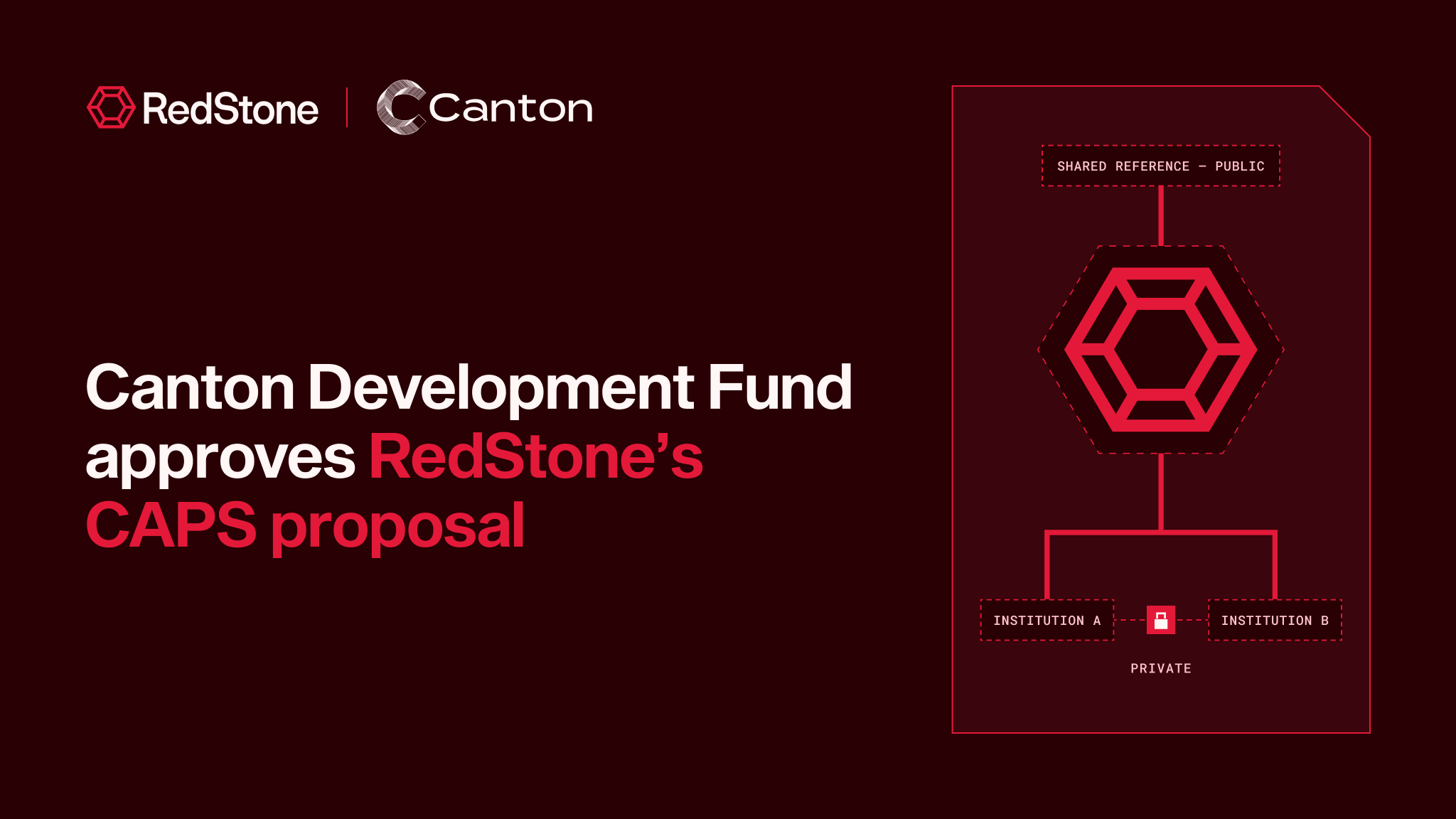
The Canton Development Fund has unanimously approved RedStone’s proposal to build the Canton Access and Privacy Standard (CAPS).
Why RedStone Built CAPS
CAPS is an open-source, Daml-native framework that lets institutions on Canton price funds, private assets and collateral without showing their positions or negotiated terms to anyone outside the deal, including the data provider.
Canton was built for institutions that treat confidentiality as a requirement. In traditional markets, large trades already happen away from public view, because an institution that announces a big position can move the price against itself before it finishes trading. Canton brought that expectation onchain. Each party sees only the trades and holdings it is part of, which is a large part of why the network has become a default venue for settling trades between institutions. More than 600 institutions have joined the network, which supports over $9 trillion in tokenized real-world assets and more than $350 billion in daily US Treasury repo transactions.
That privacy had one gap: the data provider. Almost every institutional trade needs a price from outside, and on Canton the provider delivering it normally has to be let into the contract. Once inside, it can see who is trading, what they hold and when they act, which is enough to rebuild an institution’s portfolio. The alternative, where each party fetches its own price on demand, keeps the provider out. But then two banks settling the same trade can end up with prices taken seconds apart and no rule for which one counts.
RedStone saw this as the last gap in Canton’s privacy model, and the one most likely to keep institutions from moving more of their activity onto the network. It designed CAPS to close it and first put it forward as a Canton Improvement Proposal in April 2026. Feedback from the ecosystem pointed to the Canton Development Fund as the better home for a public good, and RedStone resubmitted it there as proposal #497 in July 2026. The fund’s committee reviewed it in public and approved it on 16 September 2026. The grant pays for the engineering, and the result is a public standard any Canton participant can adopt.
How CAPS Works
In practice, RedStone posts one official price that everyone in a deal can see. Each institution then works out its own figures from that price privately. RedStone knows the price it posted, but not who used it or what for.
Take two banks doing a repo trade, where one lends cash to the other against tokenized US Treasuries. RedStone posts the Treasury price: $100. The banks agree between themselves to value the collateral at $98, a standard discount for risk. Both started from the same $100, so there’s no dispute later about which price applies. RedStone never sees the $98, the banks’ wallets or their positions. Every valuation traces back to that one posted price, which gives auditors and regulators a clear record of where each number came from.
What CAPS Opens Up
The proposal lays out the institutional use cases CAPS is built for. Each one matches activity already heading to the network:
- Tokenized funds. A fund publishes its net asset value (NAV) once. Transfer agents, custodians and distribution platforms each see the NAV relevant to their holdings, and none of them can work out another institution’s activity or assets under management.
- Private markets. A valuation agent publishes periodic fair-value assessments for private company shares. Each secondary sale gets a price that only the buyer, seller and broker can see, so the market can trade without broadcasting every deal.
- Collateral. A lending or margin workflow can read only the figure it needs, such as a liquidation threshold, and the data provider learns nothing about whose positions sit behind it. This builds on RedStone’s work pricing real-world collateral.
- Licensed market data. Premium data providers have kept their feeds off public chains because once data is published there, anyone can read it for free. CAPS includes a licensing module that enforces the commercial terms attached to the data inside the contract itself, so owners of proprietary data can serve Canton without giving their product away.
“CAPS lets institutions run repo, collateral and settlement for tokenized funds, private-market assets and structured products on Canton without revealing their positions or terms. It also gives premium data providers, like the largest traditional exchanges, a way to bring their data onchain with their licensing terms still enforced. We’re releasing CAPS as open source so the standard grows with the network and ensures widest adoption.” Marcin Kaźmierczak, Co-founder and COO of RedStone.
Teams building on Canton backed the proposal in public while it was under review, from private-credit platforms to data and infrastructure providers. Temple Digital Group, which already uses RedStone pricing for its commodity markets, plans to test CAPS as part of the rollout.
The first two implementations of CAPS are being built with Zenith and Memora as design partners. Memora plans to use CAPS for proof-of-reserves attestation, so auditors and counterparties can confirm that locked reserves match issued supply without exposing bridge flows. For Zenith, CAPS carries Canton’s privacy guarantees through to the applications that consume pricing data, so confidentiality holds end to end. Both integrations are in development alongside the CIP.
“We’ve partnered with RedStone to verify the reserves backing our wrapped assets and lay the groundwork for interoperable tokenized RWAs and regulated tokenized securities that can move between Canton and the wider crypto ecosystem.” Ryan Wishnow, Founder at Memora.
Open Source, Built for Every Provider
CAPS is not a RedStone product. RedStone will release all software components, Daml contracts, indexers and documentation under the Apache License 2.0, the same open-source license used across Canton’s Splice codebase, with no dependency on RedStone’s own services. Institutions no longer need a bespoke pricing setup for each application, and several data providers can serve the same workflows under the same privacy and licensing rules.
“Canton’s growth depends on connecting more assets, liquidity and institutions through common standards that protect sensitive data and enable interoperability. By supporting open-source initiatives like CAPS, the Foundation is helping establish a shared privacy and licensing framework that enables multiple data providers to serve the network, strengthening competition, resilience and efficiency across institutional finance.” Viv Diwakar, Head of the Canton Foundation.
Grant Scope, Milestones and Timeline
The grant at a glance:
- Length: 12 months, delivered in eight milestones.
- Size: 15,775,000 Canton Coin (CC), set at a baseline of roughly $1.83 million, with each payment adjusted to a seven-day average CC price when the milestone is accepted.
- Payment: half of the total is paid only when adoption milestones are met, such as live price feeds, bridged liquidity and trading volume that depend on CAPS.
- Oversight: Canton’s committee reviews and signs off each milestone in public on GitHub.
- Budget: the engineering team, an external security audit and forward-deployed engineers who help partners integrate. The proposal ring-fences it for the Canton ecosystem, not RedStone’s commercial data business.
The full milestone plan runs from the protocol specification and CIP in month 2 to live mainnet feeds, an external security audit and institutional onboarding in month 12. The first step is the CIP, which goes to Canton’s core and tokenomics governance for review and a vote later this year.
Why RedStone
RedStone has delivered data on Canton since December 2025, when Canton tapped it as the primary data feed infrastructure for its tokenized real-world asset ecosystem. Since then it has published its first institution-grade RWA feeds on the network and become the data layer behind a growing set of Canton applications. CAPS reuses the signed price data RedStone already produces for its data stack and repackages it into Canton-native contracts as it enters the network.
Data providers and institutions that want to build on CAPS can contact the RedStone team about joining as design partners.
Frequently Asked Questions
What is CAPS on Canton?
CAPS, the Canton Access and Privacy Standard, is an open-source, Daml-native framework for delivering pricing data on Canton. It publishes one reference price that everyone can rely on and lets each institution work out its own value privately, visible only to the parties entitled to see it.
Who created CAPS?
RedStone designed CAPS and first proposed it as a Canton Improvement Proposal in April 2026. It then submitted it to the Canton Development Fund as proposal #497, which the fund’s committee approved unanimously on 16 September 2026.
Is CAPS live?
No. CAPS is approved and in development. Delivery follows a 12-month milestone plan, starting with a Canton Improvement Proposal that goes to Canton’s governance for review later this year.
How is the Canton grant paid?
In Canton Coin, against milestones that Canton’s committee reviews in public on GitHub. Half of the total is paid only when adoption milestones are met on the network.
How is CAPS different from a standard push or pull price feed?
A push feed publishes one shared price, but the data provider can see who reads it. A pull feed keeps the provider out, but two counterparties can end up with different prices for the same trade. CAPS combines the two: one shared reference price, with each party’s own valuation kept private.
Can data providers charge for their data through CAPS?
Yes. CAPS includes a licensing module that enforces the commercial terms attached to the data inside the contract, so providers decide who can access their feeds and on what terms.
Does CAPS replace other data standards on Canton?
No. CAPS covers who can see pricing data and how it is licensed, and it is designed to work alongside standards that define how price data is formatted on Canton.
About RedStone
RedStone is the data layer for institutional DeFi, delivering secure, low-latency price feeds for digital assets, RWAs, stablecoins, LSTs, LRTs, and Bitcoin LSTs across 110+ chains. Trusted by 200+ clients, including Securitize, Morpho, Pendle, Spark, Ether.fi, Ethena, Lombard, Venus, and Compound, RedStone powers lending, stablecoins, perpetuals, and tokenized asset markets with custom pricing infrastructure built for complex onchain systems. RedStone provides data for tokenized products including BlackRock’s BUIDL, Apollo ACRED, and Hamilton Lane SCOPE. Zero mispricing events. 100% uptime. Learn more at redstone.finance.
About the Canton Foundation
The Canton Foundation is an independent, non-profit organization that stewards the governance and long-term development of the Canton Network’s shared infrastructure. The Foundation supports transparent and decentralized governance, ecosystem coordination, and participation across Global Synchronizer operators and network stakeholders, helping ensure Canton remains a reliable, fair, and trusted foundation for institutional-grade blockchain applications. The Foundation also works with financial institutions, technology providers, developers, and other ecosystem participants to support the continued growth and adoption of Canton Network globally.
About Canton
Canton is the only public, permissionless blockchain purpose-built for institutional finance, uniquely combining privacy, compliance, and scalability. With participation from leading global financial institutions and network governance independently facilitated by the Canton Foundation, Canton enables real-time, secure synchronization and settlement across multiple asset classes on a shared, interoperable infrastructure. The open-sourced network is powered by its native token, Canton Coin, and supports decentralized governance and collaborative application development. It’s the proven link between the promise of blockchain and the power of global finance, making finance flow the way it should. Learn more at canton.network.
About Memora
Memora builds infrastructure that connects digital assets, real world assets and regulated tokenized securities to the Canton Network. Its services span self-service bridging, attestations and a tokenized stock offering in development for transfer agents and issuers. The offering will support both new issuance directly on Canton and securities brought across from other blockchains, helping partners set up assets, manage authorized token workflows and connect with participating trading venues. Learn more at memora.systems.