RedStone Turns Six: Building the Infrastructure for the Next Financial Era
RedStone turns six this year.
What began as an answer to the data needs of DeFi builders now secures $9B+ across 110+ chains for 200+ clients, from BlackRock’s BUIDL to securing the most liquid pre-IPO markets onchain, like Anthropic. The assets and the market keep getting bigger, but the job never changes: price everything correctly, every block. This is how RedStone got here and where it goes next.
The pattern was there from the start: RedStone kept showing up early to assets builders wanted to build around, but nobody could price yet, from liquid restaking tokens in 2023 to Ethena’s synthetic dollar in 2024 to tokenized funds from 2025 on. It began with a problem the founders kept running into themselves.
Each asset needed a different approach. Pricing conventions that seem standard now were novel at the time, and that was the very thing that drove the founding team.
How it started?
In 2020, Marcin Kaźmierczak, Jakub Wojciechowski, and Alex Suvorov launched Limestone, a project in the Arweave Open Web Foundry that wanted to create pricing infrastructure for newer and less-known tokens that couldn’t otherwise be accepted into lending markets and were, for all intents and purposes, locked out of the DeFi ecosystem.
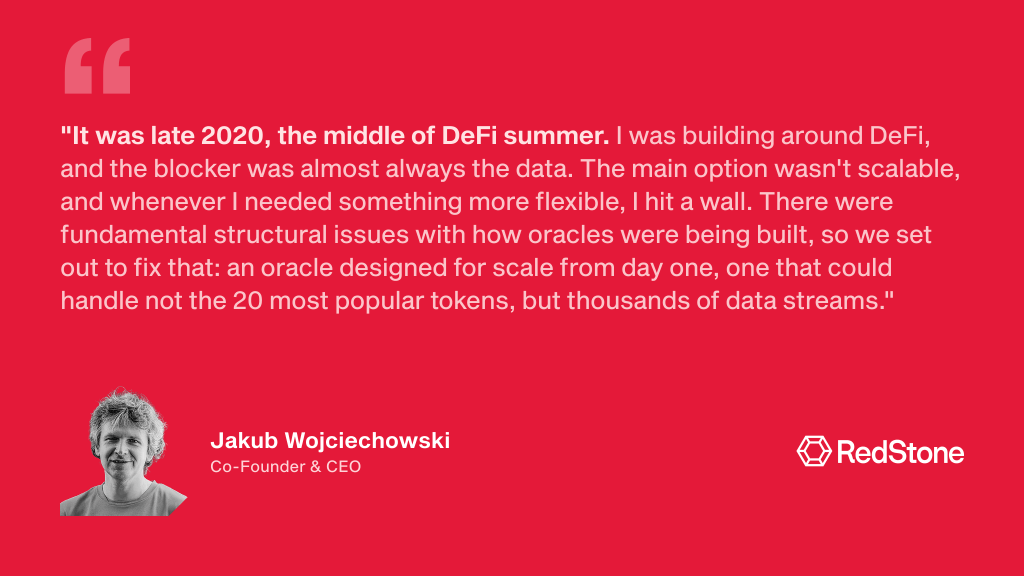
By the end of 2021, having already rebranded to the name we all know today, RedStone’s price feed coverage had grown from 100 to over 1,000 price feeds, drawing from more than 50 data sources, up from 10. The company was still in its infancy when Matt Gurbiel, VP of Business Development, joined in early 2022 as the first non-technical hire, he was employee number six:

The first commercial client arrived in January 2023. DeltaPrime, a lending protocol on Avalanche, ran RedStone’s pull model in production. The pull model suited a protocol like DeltaPrime, whose users borrow against assets most data providers did not cover, including LP positions and yield-bearing tokens: instead of paying for feeds to be pushed onchain whether or not anyone needs them, the price is delivered with the transaction that uses it. DeltaPrime is still integrated today.
How RedStone grew: pricing what no one else could
Pricing a new asset is rarely a matter of reading an exchange. Restaking tokens accrue value in the background, synthetic dollars depend on a hedge holding, and wrapped Bitcoin is worth whatever sits in custody behind it. Each of those took a different method, and RedStone built them as the assets appeared.
Liquid restaking tokens came first. RedStone deployed the first feed for weETH in December 2023. weETH is ether.fi’s restaked ETH, and its value accrues from staking rewards rather than from trading, so the price has to be derived from its redemption rate instead of read off a market.
Ethena’s USDe followed in March 2024, the first time it was priced for DeFi protocols. It needed a different approach again. USDe is backed by a delta-hedged position rather than by cash in a bank, so the thing worth watching is whether the hedge is holding.
Lombard’s LBTC came in August, with a real-time Proof of Reserves feed verifying the Bitcoin in custody behind each token. Bitcoin holders had no way to earn yield without giving up custody, and LBTC solved that, but no lending market could take it on trust. Proving the reserves is what made it usable as collateral.
Those feeds went where the lending happens. By early 2024 RedStone was the only provider behind Pendle’s markets for restaking assets, and one of two providers on Morpho Blue at launch.
Morpho now reaches people who will never read an oracle announcement. Deel’s stablecoin wallet lets contractors in Argentina hold their pay in dollars and earn on the balance through a Morpho vault on Tempo, curated by Sentora. Every position in that vault is priced by RedStone. A worker in Buenos Aires earning dollar yield on savings depends, several layers down, on a price being right.
The newest class is pre-IPO equity. When Entropy launched HIP-3 markets on Hyperliquid for two of the most-watched private companies in tech, Anthropic and OpenAI, it became the most liquid venue for pre-IPO trading. Pricing a company that has never traded publicly is a problem with no established convention, and RedStone provides the oracle infrastructure underneath those markets.
The institutional pivot
The institutional chapter started with a crucial partnership. In March 2025, Securitize chose RedStone as its primary oracle provider, and the biggest names in finance, BlackRock, Apollo and Hamilton Lane, came onchain through that single integration. RedStone began delivering onchain NAV data for its tokenized funds. A fund’s NAV comes from one place, its administrator, so the usual oracle model of aggregating many market sources does not apply. RedStone introduced the Trusted Single Source Oracle (TSSO) architecture in July to make single-source NAV data verifiable onchain.
Once Tokenization platforms began tokenizing assets, they hit the same wall everyone else had. Putting an asset onchain is only the first step. A tokenized fund or stock can move 24/7, across borders, without intermediaries, but tokenization only delivers that if the asset can actually work in DeFi: priced, lent against, and used as collateral. That takes data infrastructure the asset cannot provide on its own.
In December 2025, RedStone became the primary production oracle on the Canton Network, which holds over $6T in tokenized institutional assets. In January 2026, RedStone acquired Security Token Market and the TokenizeThis conference. The first edition under RedStone, the conference’s fourth, drew a record 500+ attendees.
Stellar came in March 2026, and RedStone adopted SEP-40, the network’s price feed standard, in June. The assets already there belonged to Franklin Templeton, Ondo and Spiko. Stellar now carries $3.5B in tokenized real-world assets across 107 assets, fourth among all networks and ahead of Avalanche, on a fraction of the asset count (rwa.xyz, 12 October 2026). Issuance at that scale only becomes useful once the assets can be priced and lent against.

RedStone Settle: Critical Settlement Infrastructure for the Tokenization Decade
Pricing an asset is one thing. Making it usable is another, especially when redemptions still take days. That is the problem we set out to solve next. In May 2026, we introduced RedStone Settle, the product that gives tokenized assets the utility people expect from crypto: instant redemptions and instant liquidations. TD Cowen projects onchain capital could reach $100T+ by 2030, but without infrastructure like this, the pace of tokenization growth hits a hard bottleneck.
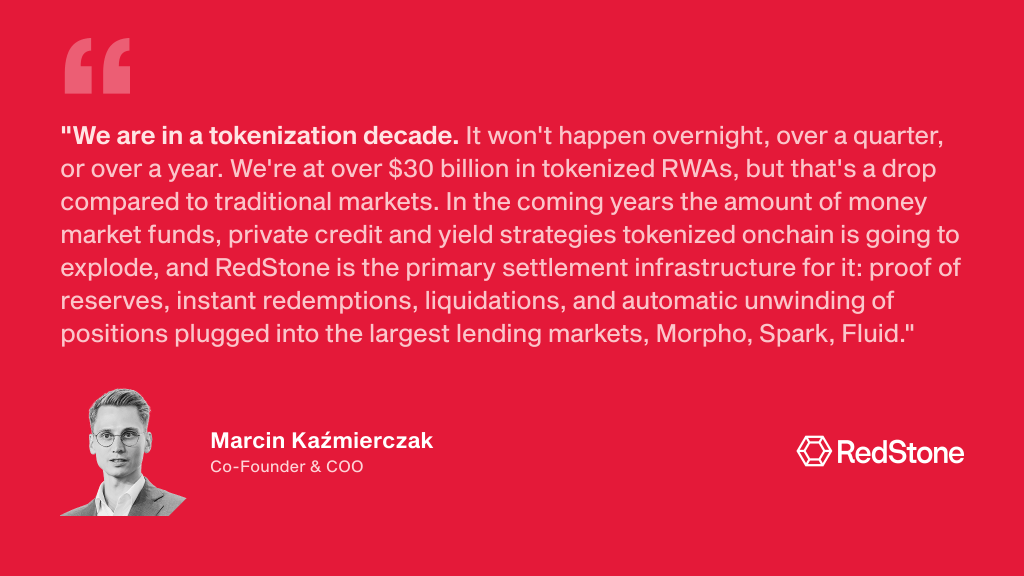
The problem with tokenized funds is that they redeem slowly, often T+3, sometimes even T+180. RedStone Settle solves two critical problems:
The first, and the most important, are instant redemptions. An investor holding a tokenized fund wants to exit the moment they decide to, the same way they would with any crypto asset, not wait days or months for the fund to redeem. Settle gives them that: whitelisted liquidity providers bid offchain to take the position, the investor is paid out immediately at T+0, and the provider holds the tokenized asset through its redemption window. The wait moves off the investor and onto a party that priced it in.
The second are instant liquidations. When a tokenized asset is used as collateral in a lending market, that market has to be able to close a position in seconds, and it never could against an asset that redeems in days. Settle runs the same auction: the protocol receives liquid collateral at T+0, and this liquidity provider takes the tokenized asset. Collateral that no lending market would accept becomes usable with Settle.

Price and settlement still leave one question open: whether an investor should be in that position at all. RedStone acquired Credora in September 2025, adding independent ratings alongside price, with each market run through 100,000 Monte Carlo simulations and graded from A+ to D. The Spark Savings USDT vault showed what a rating does to allocator behavior: it held $307M on 1 March 2026, the day Credora published its grade, and $1.4B sixty-seven days later.
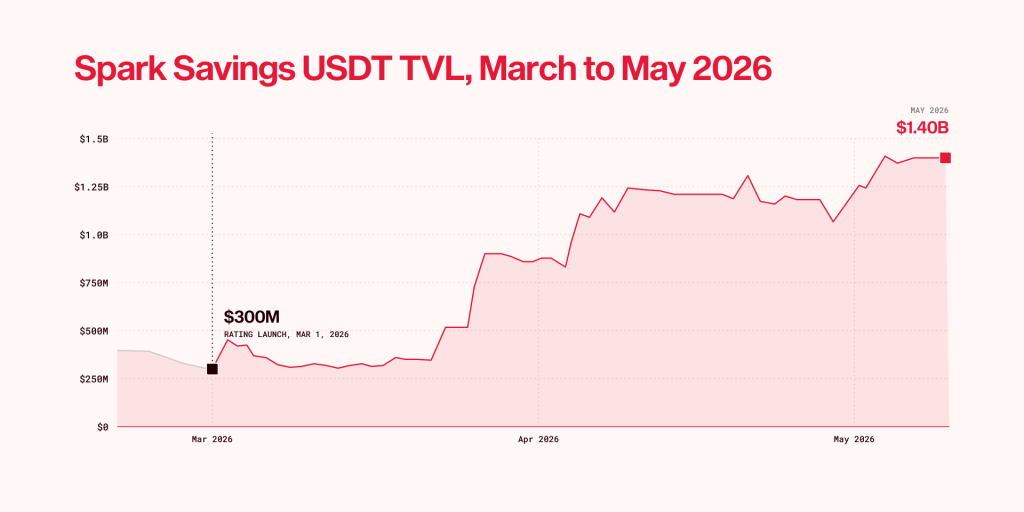
Spark Savings USDT vault, before and after the Credora rating. Source: Credora.
The Next Years For RedStone
Two forecasts frame the opportunity. TD Cowen projects onchain capital could reach $100T+ by 2030. BCG projects that tokenized assets alone could reach $16.1T by 2030.
Today, the figure stands at $39B excluding stablecoins, around a quarter of one percent of that forecast (rwa.xyz, 12 October 2026). Most of that will sit idle. Issuance is solved, but a tokenized fund that takes three days to redeem cannot be liquidated by a lending market that needs its money in seconds, so it never becomes collateral, and an asset that is not collateral is just a certificate on a different database.
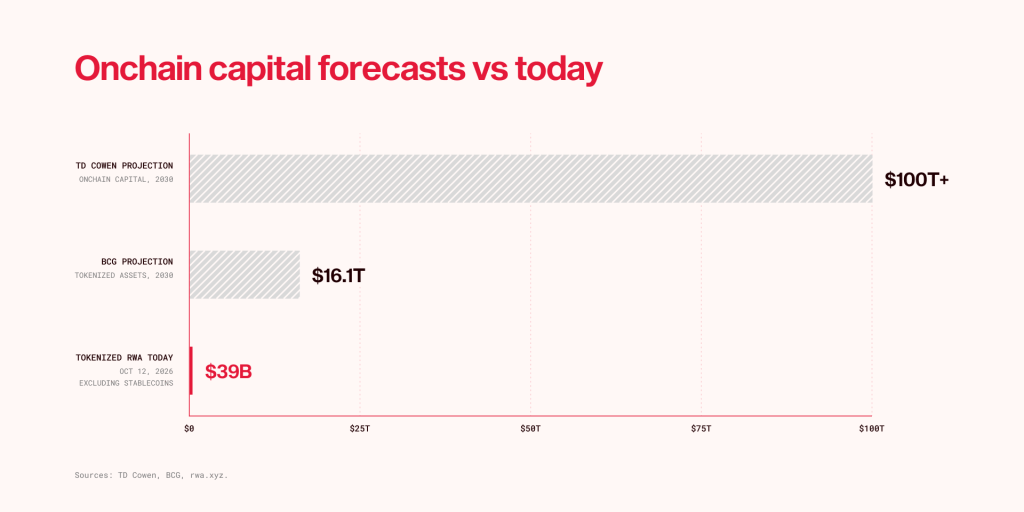
Developing and improving the infrastructure that closes this gap has been RedStone’s number one priority this past year, and it will stay that way for the years ahead.
It now handles T+0 exits for New York Life Investment Management’s tokenized high-yield bond fund, which redeems T+3 in every other venue (read more). OpenEden’s tokenized treasury runs on the same settlement rails, with more partners to be announced soon. The same logic runs through the rest of the stack: prices that keep moving when the listing exchange closes, and Credora ratings that tell a lender how a position behaves under stress rather than only what it is worth.
Compliance is the next data class after price. Institutions will not come onchain without screening that actually works, and the most-used onchain sanctions tool had gone months without an update while OFAC pushed dozens of list changes. So RedStone built the Sanctions Oracle, live on Ethereum, drawing on 463 sources including OFAC, the EU, the UN and the UK, updated onchain every week. Prices were the first thing oracles delivered.
The next five years are about making all of this routine, and no one else covers the full stack it takes: price, risk, settlement and compliance. Every major asset class priced to institutional standards, rated with independent risk intelligence, screened against sanctions, and liquidatable on demand. That is the entire pipeline an institution needs to put an asset onchain and actually use it, and it is the stack RedStone has spent six years building piece by piece.
Frequently Asked Questions
How long has RedStone been around?
Since 2020. RedStone started as Limestone in the Arweave Open Web Foundry and rebranded to its current name, “RedStone” in 2021.
How did RedStone get from a small project to pricing BlackRock’s BUIDL?
By showing up early for asset classes the rest of the market struggled to price: restaking tokens in 2023, synthetic dollars and staked Bitcoin in 2024, tokenized funds from 2025 on. Each one needed a method that didn’t exist yet, and getting them right every block, with zero mispricing events and 100% uptime, is what took RedStone from a project nobody knew to the infrastructure provider for the biggest names in the industry.
How reliable has RedStone been?
Security is the part of the job RedStone takes most seriously, and the track record shows it: six years in production with zero mispricing events. In September 2026, RedStone earned ISO/IEC 27001:2022 certification, audited and issued by SGS, adding independent third-party verification to a record that was previously self-reported. The certificate covers the full data pipeline within the specified scope, from sourcing and processing price data through onchain delivery and cryptographic key management.
What is RedStone Settle?
Settle is the product that lets tokenized assets move at the speed onchain finance needs. It enables instant redemptions, so an investor can exit a tokenized fund immediately instead of waiting out a T+3 to T+180 window, and instant liquidations, so a lending market can close an RWA-backed position in seconds. It is the infrastructure that turns a tokenized asset from something you hold into something you can actually use.
Why does tokenization need more than issuance?
Putting an asset onchain is the easy part. Until it can be priced continuously, used as collateral, and exited on demand, a tokenized fund is a certificate on a different database. The next phase of tokenization is about giving these assets real utility, and that is where RedStone is focused.
How is RedStone positioned for the $100T+ onchain future?
TD Cowen projects onchain capital could reach $100T+ by 2030. RedStone already covers the full stack that scale requires: market data priced to institutional standards, risk intelligence through Credora, and capital efficiency through Atom and Settle. The pieces institutions need are in production today, not on a roadmap.
About RedStone
RedStone is the data layer for institutional DeFi, delivering secure, low-latency price feeds for digital assets, RWAs, stablecoins, LSTs, LRTs, and Bitcoin LSTs across 110+ chains. Trusted by 200+ clients, including Securitize, Morpho, Pendle, Spark, Ether.fi, Ethena, Lombard, and Compound, RedStone powers lending, stablecoins, perpetuals, and tokenized asset markets with custom pricing infrastructure built for complex onchain systems. RedStone provides data for tokenized products including BlackRock’s BUIDL, Apollo ACRED, and Hamilton Lane SCOPE.