The RedStone Podcast Ep2: Ava Labs on Staying Compliant but Connected
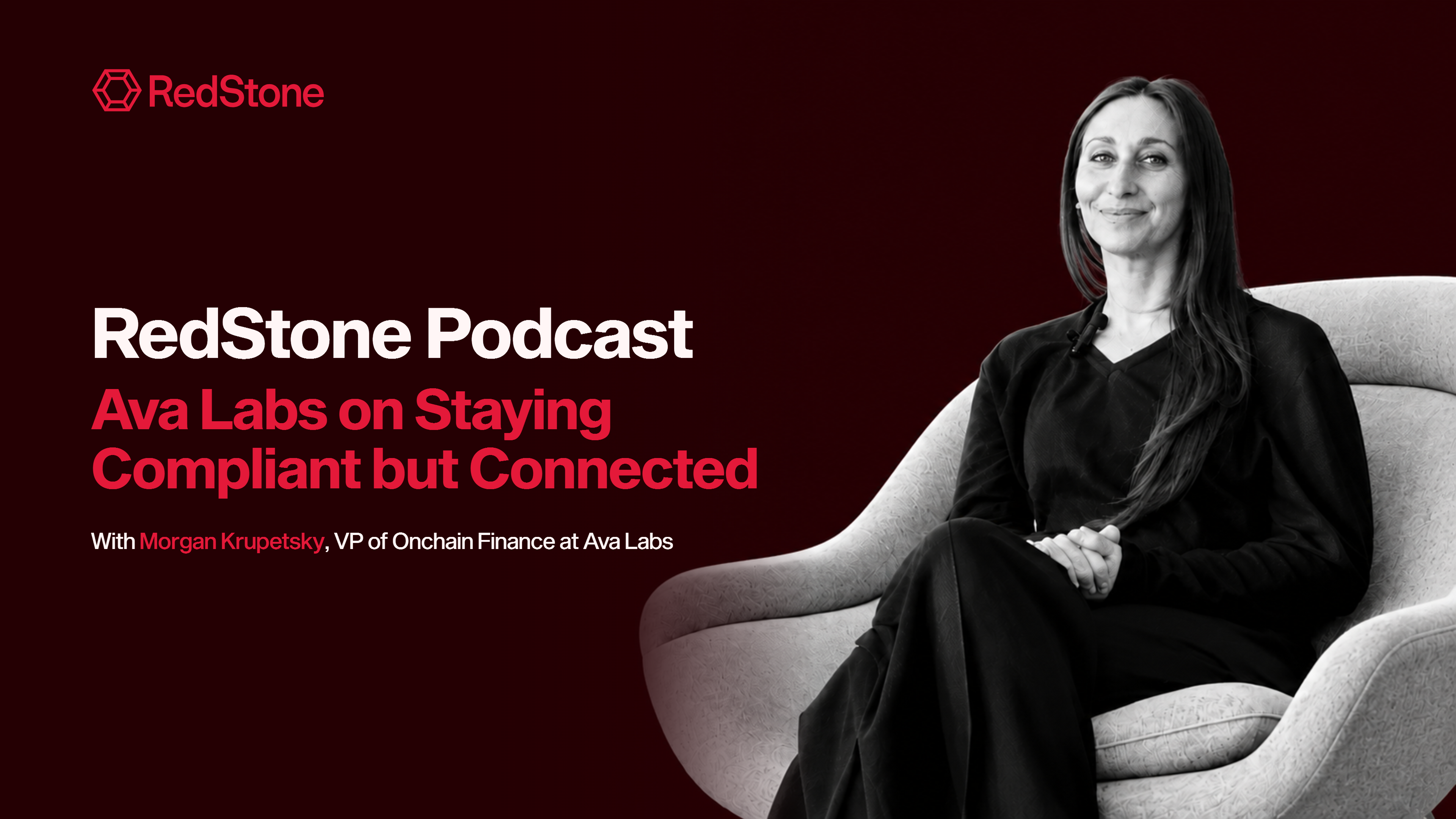
Every week on The RedStone Podcast, we sit down with the people building institutional finance onchain for five minutes: long enough to take the industry’s pulse and hear what’s on the mind of the founders, asset managers, and market-infrastructure leaders that are building it.
No long rants or forty-minute origin stories, no filler or padding. The signal, condensed and delivered to your screen. This week, Mike Massari, Head of Partnerships at RedStone, sits down with Morgan Krupetsky, VP of Onchain Finance at Ava Labs.
Morgan Krupetsky leads global business development at Ava Labs. She works with the banks, asset managers, fintechs, and payment companies building financial applications on the Avalanche network.
Before Avalanche, Krupetsky spent more than a decade at Citibank, working on the institutional FX and macro sales desks and later serving as chief of staff to Citi’s chief compliance officer. She spent those years handling the very same questions and objections that keep banks and asset managers away from the digital asset space
As someone who has now sat on both sides of that desk, Krupetsky understands what an institution needs before it will even consider bringing its operations onchain.
Permissionless vs Permissioned
For a long time, institutions looking to bring any part of their business onchain faced two options, each with a real drawback.
A permissionless network like Ethereum or Solana offered liquidity and composability, but everything on it is public by default. Transaction sizes, timing, counterparties, and open positions are visible to anyone willing to look for them. And despite being public, these networks are pseudonymous by design, which makes KYC impossible to enforce at the protocol level.
Scalability and performance were a real drawback for a long time too. So even for institutions that recognized how decentralized technology could reshape finance, no bank was willing to move to a system where compliance, privacy, and performance all got sacrificed for the decentralization ethos.
On permissioned networks, privacy and performance meant being walled off from the entire ecosystem. An enterprise chain built on something like Hyperledger Fabric or R3’s Corda restricted access to approved participants, which cleared the confidentiality and compliance bar, but it cut the institution off from the liquidity, assets, and applications that made going onchain worthwhile in the first place.
Connectivity for Enterprise Finance Onchain
Avalanche has been working to fill this gap since 2023. Its answer was to empower institutions to run their own L1 blockchain, a network where the rules can be customized and enforced by the operator itself. That means institutions can control specs like the network’s native gas token, permissioning and privacy, validation and consensus, and KYC/KYB processes.
Unlike traditional permissioned solutions, Avalanche’s chains stay connected without giving up privacy or permissioning. They verify each other directly, with no bridge in between, so an institution keeps its controlled environment while still reaching the rest of the Avalanche network and assets.
“Allowing institutions to spin up their own layer one blockchain environments that are fully compliant and controlled and meet the specific regulatory and business requirements of a particular institution while still being interconnected with the broader network.”
Banks, fintechs, and government agencies each have their own reasons for integrating blockchain technology, along with their own restrictions and rules to follow. A dedicated L1 lets them set their own terms without giving up the network around them. Ava Labs made this the core of its “Technology Built for Business” positioning, which points at what enterprises already run on Avalanche in production.
Permissioned Doesn’t Mean What You Think
The first thing Morgan has to undo in a room full of risk officers is the assumption that onchain means wide open. Much of the job is education, and one myth comes up more than any other: that putting an asset onchain hands it to anyone who wants it.
Controls exist at the token level, the wallet level, the application level, and on Avalanche at the chain level too. An institution decides who can hold what, and where. What surprises the risk teams is that the controls can be an upgrade. When compliance rules live in the infrastructure, they run continuously, checking each transaction as it happens.
“This technology allows you to manage compliance risk in real time and proactively, which is in many cases an improvement upon how traditional compliance works today.”
Where Comes Next
That same instinct, building the rules in rather than bolting them on also applies to what Morgan points to as being the next frontier for onchain finance: credit, specifically asset-backed finance and fintech lending. Today most onchain credit is a loan made the traditional way, then wrapped in a token after the fact.
The next step is originating the loan onchain from the get-go, so the underwriting, verification, and servicing all happen in the same environment instead of being reconciled back to an offchain record later.
“Introducing the technology as far upstream as possible, at the point of origination.”
Wrapping a finished loan just adds a token on top of the old process. Building it onchain is the only version that makes sense and leaves only a single record behind, one that is digital and immutable by nature.
The Next Unlock
Avalanche and others have been paving the way for institutions to move from legacy systems onto blockchain infrastructure. Much of that infrastructure is already in place or close to it. What decides how fast the rest follows is compliance and regulation, the same requirements that kept institutions cautious in the first place, and the same ones Morgan spends her time addressing.
“There’s different levels of permissioning and risk controls, whether it’s at the token level, the wallet level, the application level, or in Avalanche’s case, also the blockchain level.”
Frequently Asked Questions
What is an Avalanche L1?
A dedicated blockchain an institution can launch with its own fee token, validator set, and parameters, configured to meet its own compliance and governance rules. Unlike a walled-off private chain, an Avalanche L1 stays interconnected with the broader network, so the institution keeps control without cutting itself off from liquidity and applications elsewhere.
Does putting an asset onchain make it permissionless?
No. Permissioning and controls can be enforced at several layers: the token, the wallet, the application, and, on Avalanche, the chain itself. An institution decides who can access and hold an asset. Morgan’s argument is that these controls can let a firm manage compliance risk in real time, which can improve on traditional periodic checks.
Why couldn’t institutions just use Ethereum or Solana?
On a public network everything is visible by default, transaction sizes, timing, counterparties, and positions, and KYC can’t be enforced at the protocol level. For a bank, running its book in the open is a non-starter, which is why a controlled but connected chain became the workable middle ground.
About RedStone
RedStone is the data layer for institutional onchain finance, delivering secure, low-latency price feeds for digital assets, RWAs, stablecoins, LSTs, LRTs, and Bitcoin LSTs across 110+ chains. Trusted by 200+ clients, including Securitize, Morpho, Pendle, Spark, Ether.fi, Ethena, Lombard, Venus, and Compound, RedStone powers lending, stablecoins, perpetuals, and tokenized asset markets with custom pricing infrastructure built for complex onchain systems. RedStone provides data for tokenized products including BlackRock’s BUIDL, Apollo ACRED, and Hamilton Lane SCOPE. Zero mispricing events. 100% uptime. Learn more at redstone.finance.
About Ava Labs
Ava Labs supports Avalanche, an open-source platform for launching highly decentralized applications, new financial primitives, and interoperable blockchains. The network’s speed, scalability, and eco-friendliness make it a preferred choice for Web3 developers. For more information, visit avalabs.org.