How RedStone Solved the FX Time Dilemma to Bring 24/7 Turkish Lira Yield Onchain with Brix
Table of Contents (11 sections)

Key Results in Numbers
Partner Perspective
Challenge – When Wall Street’s Clock Hits DeFi’s Continuum
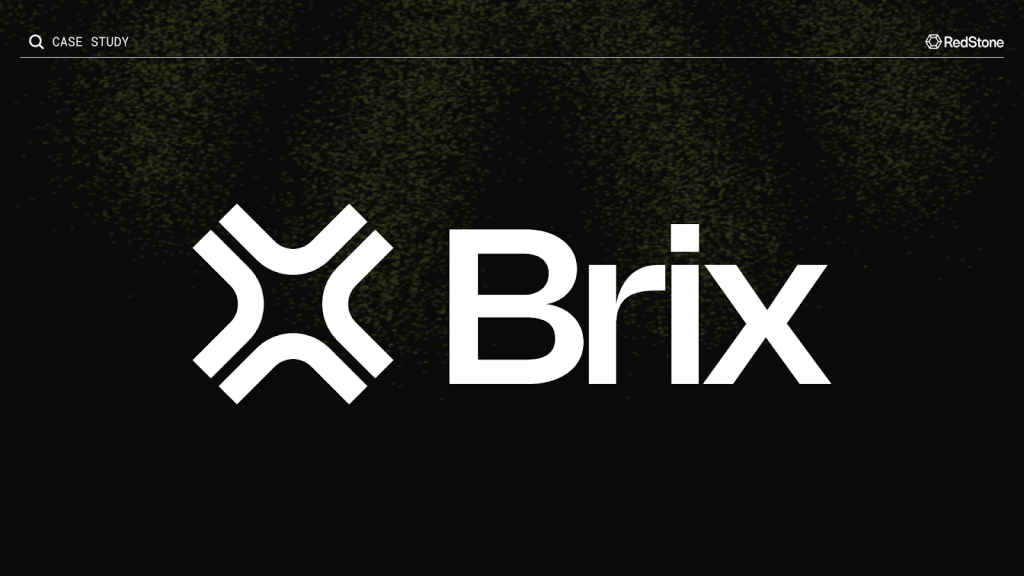
Brix tokenizes sovereign carry trade exposure, starting with the Turkish lira, and transforms a global macro strategy into a programmable on-chain primitive product. The ambition was to give any stablecoin holder access to the kind of emerging-market yield (~40% APY) typically reserved for institutional desks, generated by sovereign monetary policy, not fleeting liquidity-mining rewards.
Replicating that strategy on-chain surfaced a structural problem that no standard oracle could solve.
The core tension: FX markets operate on fixed schedules. Blockchains run continuously.
This fundamental mismatch between the discrete, scheduled world of traditional finance and the 24/7/365 continuum of the blockchain created three existential threats to the Brix protocol:
- Pricing gaps. Any oracle relying solely on traditional FX desks would go dark for a significant portion of every week, leaving Brix tokens without a valid price during off-hours.
- Distorted yield and economic drift. The NAV of the underlying Digital Liquidity Fund drives yield distribution to wiTRY stakers. Lag in that data leads to inaccurate payouts and, more dangerously, could cause the token’s peg to drift from its underlying value.
- Composability failure. DeFi protocols integrating Brix assets need on-chain price feeds they can trust and inspect. Without a verifiable, always-on data layer, no external protocol could safely use Brix tokens as collateral, and the entire DeFi integration thesis collapses.
A further layer of complexity: Brix needed to bridge real-world infrastructure, prime brokers, Turkish banking partners, and the Digital Liquidity Fund into on-chain smart contracts. Without a decentralised data layer in between, every NAV update would require a manual, centralised process. That is the exact model Brix was built to replace.
Engineering a Hybrid Time-Stream
The solution to a time paradox could not be found in a standard oracle toolkit. It had to be engineered from first principles. RedStone was uniquely positioned to architect the answer: a hybrid, adaptive feed designed specifically for the temporal eccentricities of emerging-market assets. The core innovation was to reject the binary choice between institutional FX data and decentralized exchange data. Instead, RedStone built a system that unifies both into a single, coherent, and perpetual price stream. It’s an oracle that is context-aware, intelligently switching between sources to ensure the data never sleeps, effectively creating a bridge between two different financial realities.
How the Feed Works
Phase 1: Market Hours: During traditional finance operating hours, the oracle taps directly into institutional-grade FX data streams used by professional macro traders. This data undergoes rigorous validation before being cryptographically signed by RedStone’s decentralized network of data providers and anchored on-chain. This is the voice of Wall Street, speaking with precision.
Phase 2: Off-Hours: The moment the institutional markets fall silent, the feed’s logic pivots. It seamlessly transitions to a CEX aggregation model, sourcing TRY pricing from high-volume, perpetual markets like Binance. This ensures the data stream remains unbroken, providing a reliable price even at 3 AM on a Sunday. This is the voice of the always-on, decentralized world.
This hybrid methodology is the technical core of the integration. It required a custom feed architecture that no off-the-shelf oracle configuration could deliver.
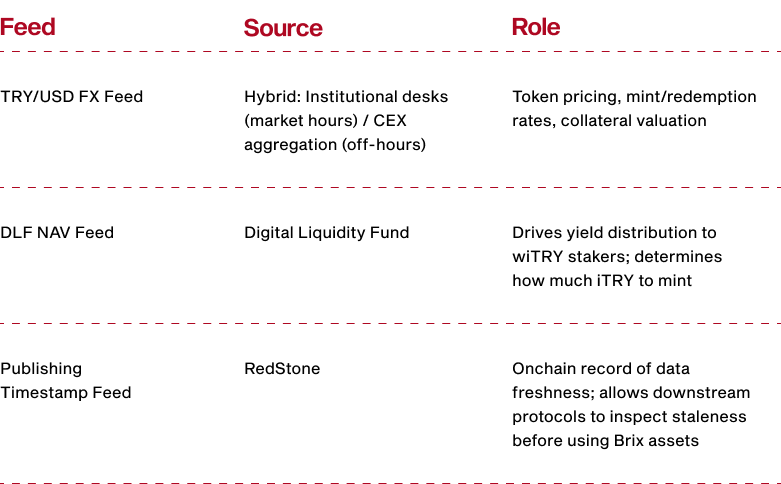
The Three Feeds
Where RedStone Sits in the Stack
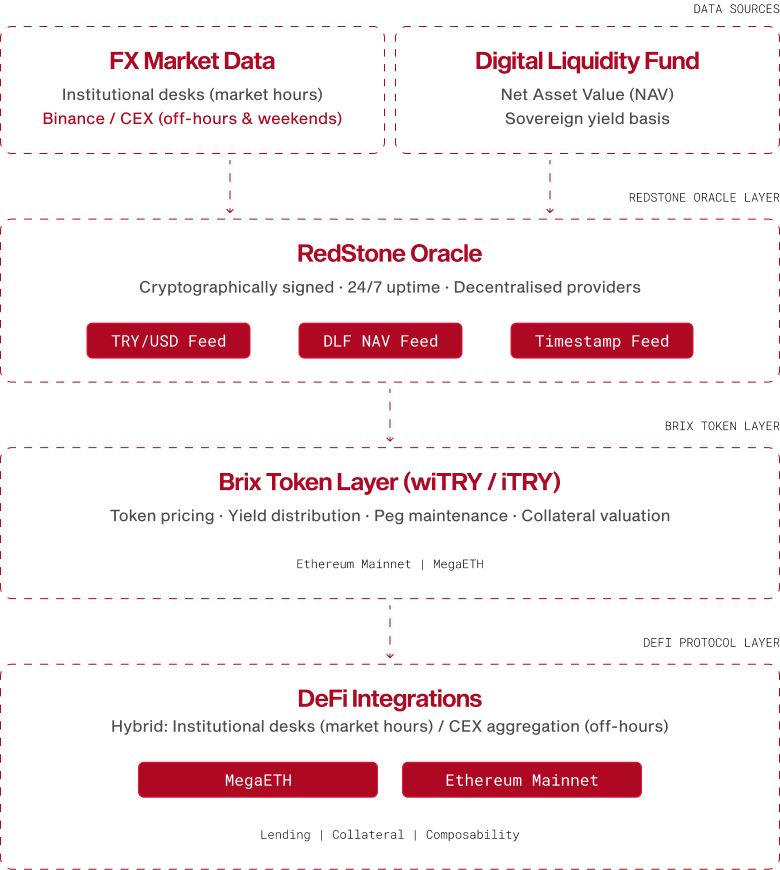
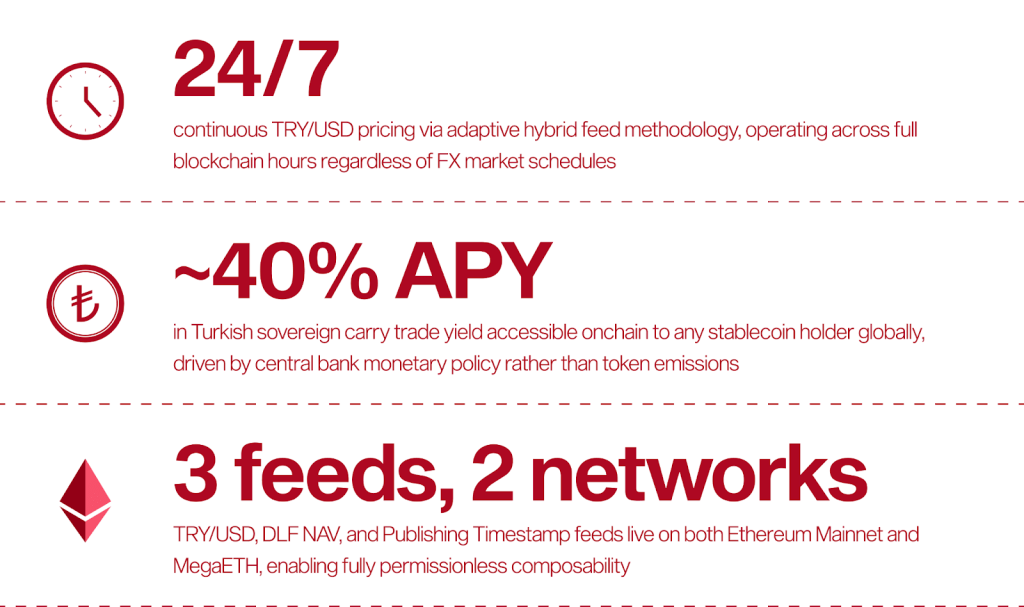
RedStone sits at the critical junction between real-world data and onchain logic. The feeds are the mechanism that makes the token function, not a background service that can be swapped out.
Impact
System Performance
The adaptive hybrid feed eliminated the pricing gaps that would otherwise occur during off-market hours. TRY/USD data is continuously available on-chain, aligning with the always-on nature of the blockchain environment Brix operates in. The Publishing Timestamp feed gives downstream protocols a real-time signal for data freshness, preventing any protocol from acting on stale data without visibility.
Security & Data Integrity
At its core, this integration replaces fragile, centralized price updates with cryptographic certainty. Every data point is signed by RedStone’s decentralized network of providers, creating a robust defense against manipulation. For the Brix ecosystem, this translates into a cascade of security guarantees:
- Accurate collateral valuations, preventing unfair liquidations in any lending protocol that integrates wiTRY
- Correct NAV calculation, so yield distributions precisely reflect actual Digital Liquidity Fund appreciation
- Peg integrity, since stale or incorrect pricing is the primary mechanism through which the iTRY peg can drift, and continuous feeds directly address that risk
- Arbitrage prevention, as live and correct pricing closes the window where users could mint or redeem at rates disconnected from real NAV
Business & Network Impact
The integration enabled capabilities that were architecturally impossible before:
- Permissionless composability. The RedStone feeds provide a trustless, on-chain source of truth, satisfying the non-negotiable prerequisite for deep DeFi integration. Any DeFi protocol on the Ethereum mainnet or MegaETH can now consume Brix asset pricing without trusting Brix to manually update prices. This is a hard requirement for serious protocol integrations.
- Accessible sovereign yield. The ~40% annualised yield from Turkish central bank policy, historically locked behind banking bureaucracy and geographic capital controls, is now accessible to any stablecoin holder globally.
- Decentralised NAV publication. The full yield reporting and distribution mechanism operates without Brix as a trusted intermediary, satisfying the trust-minimisation requirements that DeFi protocols demand from collateral assets.