Next Phase for RWAs on Stellar: Putting $3.5 Billion to Work
The controls that brought institutional issuers to Stellar also keep their assets out of DeFi. What is tokenized, how much of it works as DeFi collateral, and what closes the gap before DTCC arrives in 2027.
RedStone Research · October 2026 · Data as of October 16, 2026
0.1 · Executive summary
Six Things To Know
Stellar builds holder approvals, freeze, and clawback into the protocol, and that has been part of what made it one of the largest RWA networks. But a lending market only works if anyone can seize and sell collateral, and those controls prevent exactly that. DTCC's arrival in 2027 makes the gap more urgent.
01
$3.56B in distributed RWAs
Up 5.5x in a year. Stellar is the fourth-largest RWA network on rwa.xyz, and funds account for around three quarters of that value.
02
About 0.1% is used as collateral
Almost all of it is one open wrapper, Centrifuge's deJAAA, in Templar's lending markets. None of the gated funds from Spiko, Franklin Templeton, Realiz, or WisdomTree sits in a smart contract yet. Collateral use is low on other chains too: on BNB Chain and Avalanche, none of the largest tokenized funds backs loans, and on Ethereum only about 1% of the largest Treasury funds does.
03
Few onchain exits
83% of RWA value has no onchain market at all. A liquidator that seizes these assets has nowhere onchain to sell them.
04
Loan terms follow the exit
Templar lends up to about 95% of the collateral's value (a 95% loan-to-value, or LTV) against deJAAA, an AAA wrapper anyone can hold and trade. For comparison, on BNB Chain, Venus caps tokenized Tesla and Nvidia at 60% LTV, though both stocks are among the world's most liquid, because their exit runs through an issuer, and the stock market closes overnight and on weekends.
05
Ratings often stop at the underlying
The only credit rating in a deJAAA loan is the AAA on the collateralized loan obligations (CLOs) the fund holds. Nothing rates the fund, the token, or the layers DeFi adds on top: the bridge to NEAR, Templar's lending market and the vault that supplies the USDC.
06
DTCC raises the stakes
DTC-custodied assets are expected on Stellar in the first half of 2027, and they can move only between registered wallets of DTC participants.
01
RWAs on Stellar: $3.5B+ and Growing
As far as Stellar's architecture goes, the expansive growth of RWAs on the network has been to a large degree driven by the presence of protocol-level issuer controls. That same feature keeps almost all of the RWA issuance on Stellar out of DeFi.
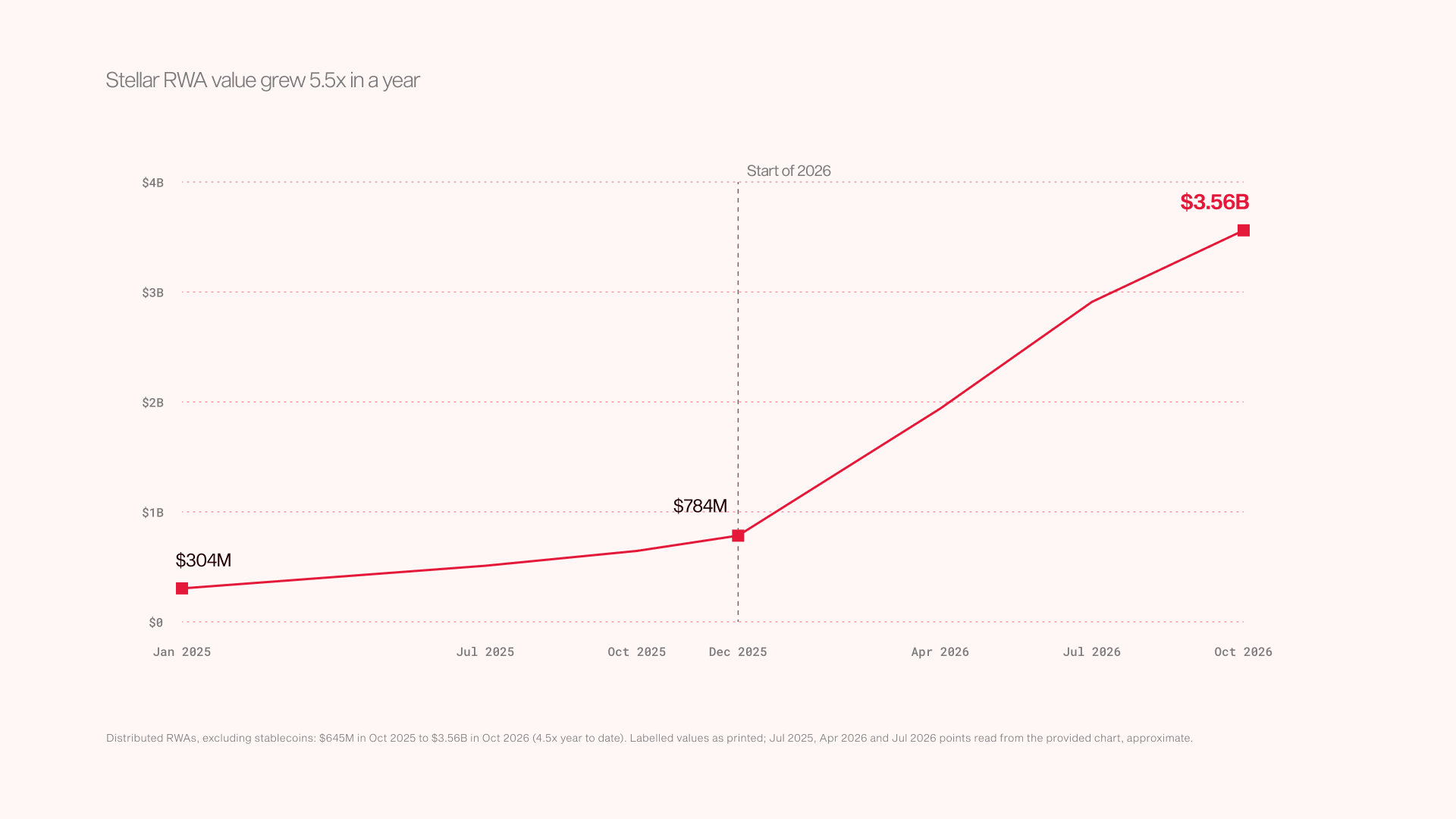
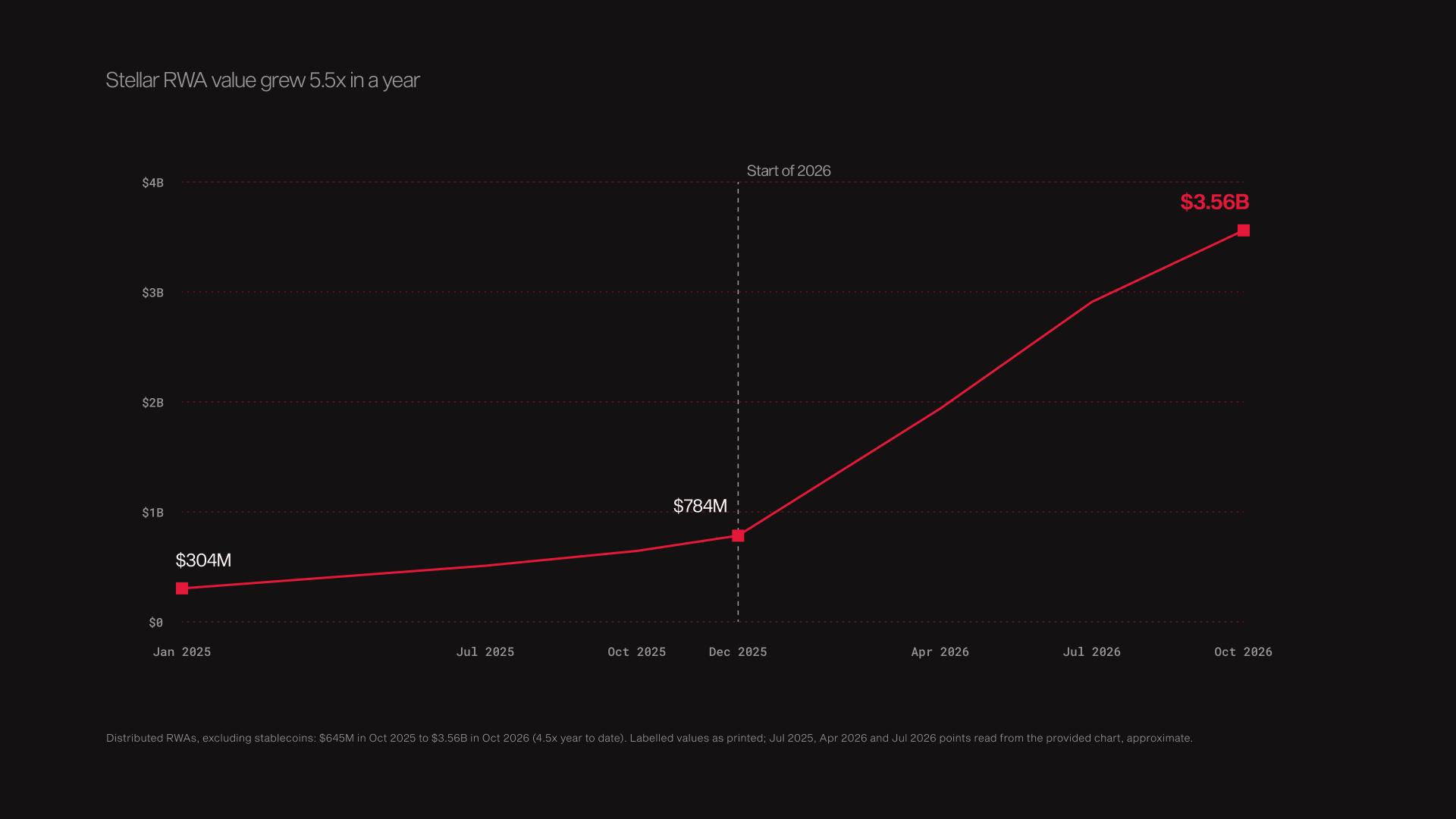
Stellar holds $3.56B worth of onchain value across its RWA sector, up from $784M at the end of 2025 and $645M a year ago. That is 4.5x year to date and 5.5x year on year.
Figure 1
Stellar RWA value grew 5.5x in a year
Distributed RWA value on Stellar. Source: rwa.xyz, as of October 16, 2026.
Stellar ranks fourth by distributed RWA value on rwa.xyz, behind Ethereum ($16.97B), BNB Chain ($5.92B) and Solana ($4.37B), and ahead of Avalanche ($1.66B). It gets there with 83 assets. The average Stellar RWA carries $42.8M in tokenized onchain value, compared with $5.3M on Ethereum and $1.3M on Solana. That is what institutional issuance looks like: few assets, large tickets, mostly funds.
The value is concentrated. The top five assets account for 87% of it, and Spiko alone holds 51.6% across nine tokens. Distribution is widening, though: RWA holders rose 14.5% in 30 days to 23,706, and 30-day RWA transfer volume reached $642M.
1.1Who holds it
The median Stellar RWA address holds $2,689 in tokenized onchain value, while the average holds $212,000. Across 16,755 addresses with a non-zero RWA balance, 39 addresses of $10M or more hold 55% of all value. The top 10 hold 42%, and the top 1% (168 addresses) hold 70%; however, these likely include infrastructure addresses, such as those managed by transfer agents or issuer distribution arms.
Holding per address
Addresses
Share of addresses
Share of value
Under $1K
7,355
43.9%
<0.1%
$1K to $10K
2,223
13.3%
0.2%
$10K to $100K
4,492
26.8%
5.0%
$100K to $1M
2,335
13.9%
18.0%
$1M to $10M
311
1.9%
22.0%
$10M and above
39
0.2%
54.8%
Source: StellarExpert holder lists and Soroban contract storage, October 16, 2026.
The split is by product. Spiko's funds look like a professional investor base, with median holdings of $17,751 in eurSAFO and $18,303 in EUTBL, and no wallet above 5% of either. The large US Treasury tokens are concentrated in a few wallets with a long tail of small balances. One address holds 76% of USDY, and the median USDY holder has $7. The largest BENJI wallet holds 47%, and the median is $79. The single largest address is the $500M VuMe Bond wallet. Again, when considering these figures, one has to account for the fact that they likely include infrastructure wallets.
These balances were pulled onchain on October 16 from StellarExpert: holder lists for classic assets and Balance entries in contract storage for Soroban tokens. They cover 47 assets and $3.554B of the $3.555B rwa.xyz total, priced at rwa.xyz value divided by onchain supply. One address holding several assets is counted once. That is why the count here (16,755) is lower than rwa.xyz's 23,706 holders: rwa.xyz counts an address once for every RWA it holds, while we count each address with a non-zero balance once.
1.2Why Stellar
Issuers on Stellar get the controls a transfer agent needs as part of the protocol, which spares the issuer the need to wire them up for every asset separately. Onchain, the pattern is close to universal: 97.8% of the $1.16B in RWAs issued as classic Stellar assets has clawback enabled (the issuer can pull tokens back from any wallet), based on Horizon asset flags read on October 16, 2026.
Control at the protocol level
Every classic Stellar asset carries issuer flags that wallets, exchanges, and protocols read the same way:
Authorization required. A wallet opens a trustline, Stellar's opt-in record that lets an account hold a specific asset, and the issuer must approve it before the wallet can hold the asset. That is a native allowlist for KYC'd holders.
Freeze (revocable). The issuer can revoke a trustline's authorization, which freezes the balance and cancels open offers. It can also drop a holder to a limited state that blocks transfers but lets them unwind positions.
Clawback. Added in Protocol 17 in 2021, clawback lets the issuer reclaim a balance without the holder's key. It requires the freeze flag. Stellar positions it for court orders, regulatory actions, and lost keys.
The flags are visible before anyone opts in, and they behave identically across assets. On EVM chains, each issuer encodes these controls in its own contract, and every integrator has to read that contract. On Stellar, a fund administrator, a wallet, and a lending protocol all see the same switches.
Asset
Issuer
Value on Stellar
Auth required
Freeze
Clawback
USDY
Ondo
$537.5M
No
Yes
Yes
BENJI
Franklin Templeton
$441.7M
Yes
Yes
Yes
gBENJI
Franklin Templeton
$56.8M
Yes
Yes
Yes
sgBENJI
Franklin Templeton
$27.0M
Yes
Yes
Yes
SPX (SpaceX bond)
NYALA
$26.9M
Yes
Yes
Yes
SPXUX
WisdomTree
$18.9M
Yes
Yes
Yes
USTRY
Etherfuse
$12.4M
No
Yes
Yes
CETES
Etherfuse
$3.7M
No
Yes
Yes
BB1
Bitbond
$3.0M
No
No
No
RVL4, RVL5
Rivool Finance
$18.4M
No
No
No
Source: Horizon asset flags, October 16, 2026.
The same holds for regulated stablecoins: Figure's YLDS, SG-Forge's EURCV, and Paxos's PYUSD all have clawback on. Circle's USDC is the exception, with freeze but no clawback.
Soroban: the same controls, written in code
Most of the value has moved beyond classic assets. Two thirds of Stellar's RWAs, $2.37B, sit in Soroban token contracts: Spiko's funds, Realiz's VuMe Bond 2030, and Centrifuge's deRWA tokens. Here, permissioning lives in contract logic. Every transfer of Spiko's eurSAFO, for example, calls safe_transfer with an approval signature attached. Centrifuge's deRWA tokens take the opposite approach: freely transferable, with only a blocklist.
SEP-40: one way to read a price
Controls make issuance possible; pricing makes it usable. SEP-40 is Stellar's standard oracle interface for Soroban contracts. It fixes the calls a protocol uses (lastprice, price, prices) and attaches a timestamp to every price, so a lending market can check staleness, compute a time-weighted average price (TWAP), which dampens a single bad print, and switch or combine providers without rewriting its logic. RedStone and Reflector both implement it. In our August report, 18 of the 47 Stellar feeds were implemented with the SEP-40 standard. As of late October, that count is at 21 feeds.
The cost and speed are also there: on Stellar, fees average about $0.0003, and ledgers close in roughly five seconds. So does the track record. Franklin Templeton has run its government money fund on Stellar since 2021.
1.3Mapping RWAs on Stellar
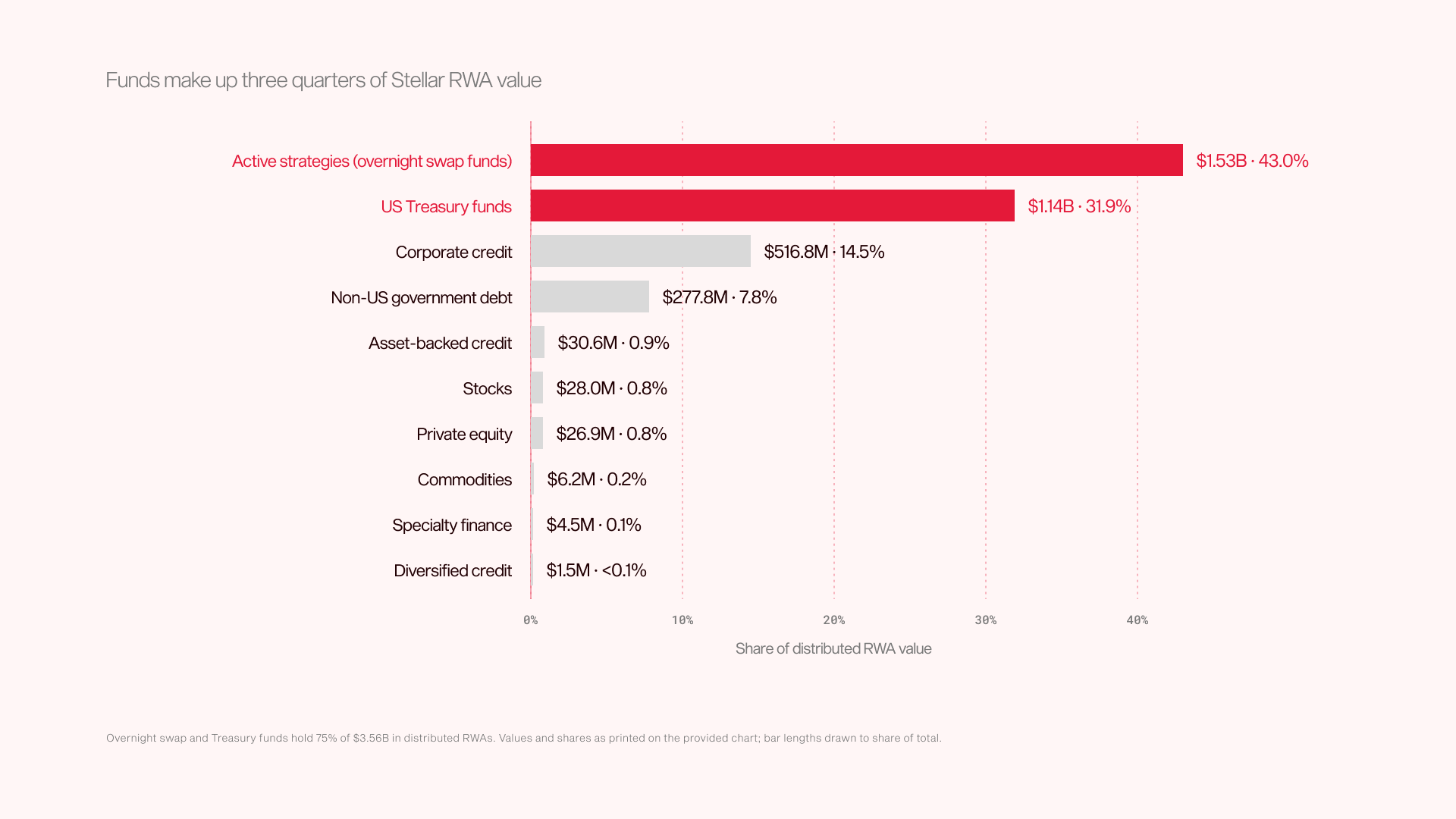
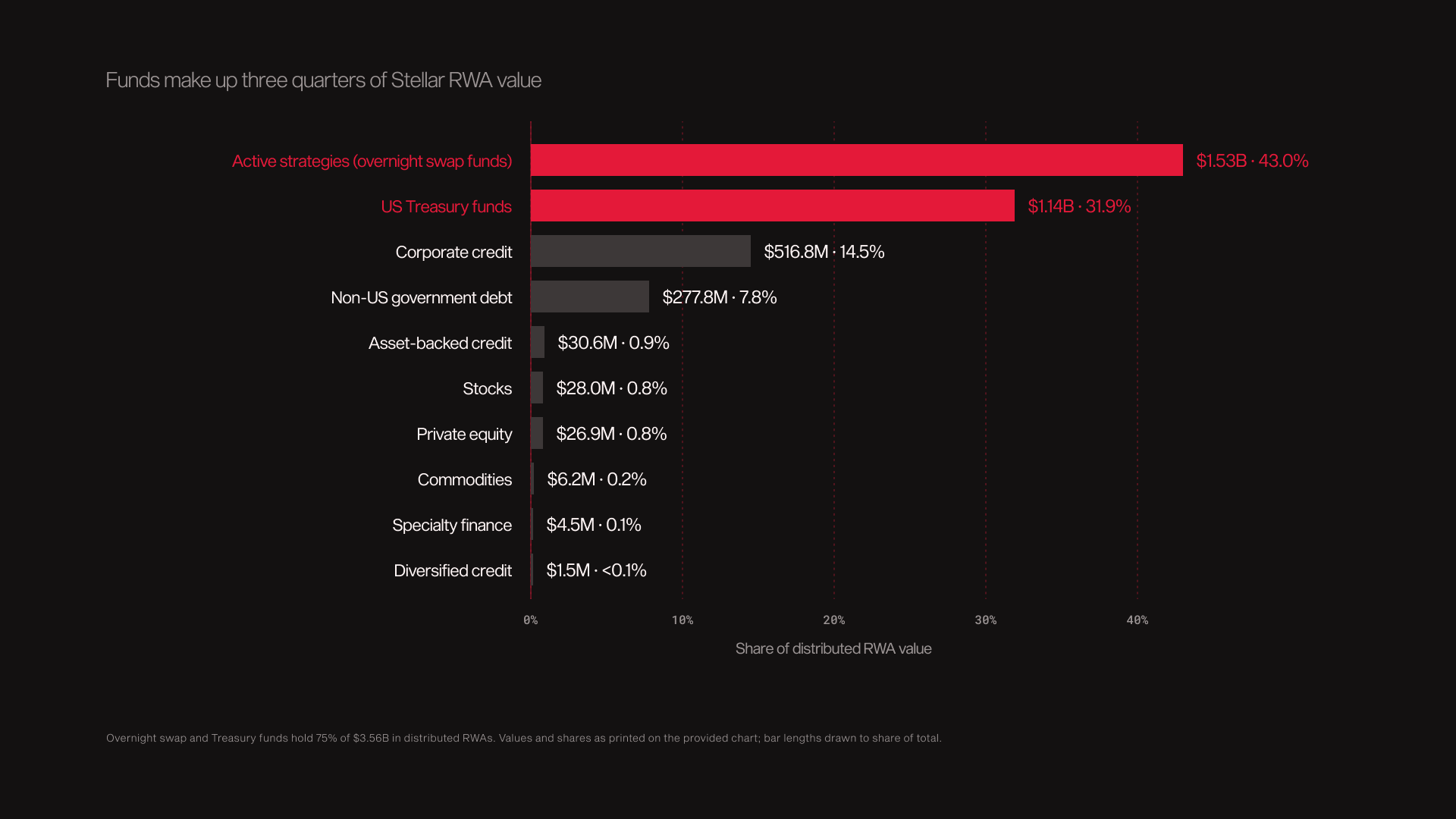
Stellar's RWA sector is dominated by funds. Overnight swap funds and Treasury funds hold 75% of the value, corporate credit adds 15%, and everything else (stocks, private equity, real estate, gold, receivables) adds up to under $100M.
Figure 2
Funds make up three quarters of Stellar RWA value
Distributed RWA value by asset class. Source: rwa.xyz, October 16, 2026.
Here is the list of top 15 largest assets out of 83, as mapped on October 16 (holder counts from rwa.xyz):
Asset
Issuer / platform
Asset class
Value
Holders
Issuance
eurSAFO
Spiko (Amundi, manager)
Overnight swap fund
$1,355.0M
10,456
Soroban
USDY
Ondo
US Treasury note
$537.5M
1,366
Classic
TPT30 (VuMe Bond 2030)
Realiz
Corporate credit
$500.0M
1
Soroban
BENJI
Franklin Templeton
US Treasury fund
$441.7M
1,104
Classic
EUTBL
Spiko
EU T-bill fund
$261.0M
2,377
Soroban
SAFO (USD)
Spiko (Amundi, manager)
Overnight swap fund
$116.0M
781
Soroban
gBENJI
Franklin Templeton
US Treasury fund
$56.8M
9
Classic
gbpSAFO
Spiko (Amundi, manager)
Overnight swap fund
$48.1M
359
Soroban
USTBL
Spiko
US T-bill fund
$33.0M
433
Soroban
sgBENJI
Franklin Templeton
US Treasury fund
$27.0M
10
Classic
SPX (SpaceX bond)
NYALA / Cometum
Private equity
$26.9M
101
Classic
SPXUX
WisdomTree
Stocks (S&P 500 fund)
$18.9M
190
Classic
UKTBL
Spiko
UK T-bill fund
$12.8M
347
Soroban
USTRY
Etherfuse
US Treasuries
$12.4M
467
Classic
deJTRSY
Centrifuge (Anemoy)
US Treasury fund
$10.6M
301
Soroban
Source: rwa.xyz, StellarExpert, October 16, 2026.
Overnight swap funds, $1.53B. This category is one product. Spiko's tokenized share classes of the Amundi-managed Overnight Swap Fund (SAFO) launched in March 2026 with $100M committed on Ethereum and Stellar. On Stellar, the euro class alone is now $1.35B, and its contract has processed 61,702 payments since its first transaction on March 6.
US Treasuries, $1.14B. Ondo's USDY ($537.5M) and Franklin Templeton's BENJI family ($525.5M across three tokens) make up most of it. Onchain, USDY's supply is 467.5M tokens; at USDY's current price, that matches rwa.xyz's value. The rest comes from Spiko, Etherfuse, Centrifuge and WisdomTree's tokenized funds.
Corporate credit, $517M. This is almost all Realiz's VuMe Bond 2030, a single $500M position held in one wallet. Centrifuge's JAAA wrappers and Bitbond's BB1 make up the remaining $17M.
Non-US government debt, $278M. Spiko's euro T-bill fund (EUTBL) accounts for $261M. Etherfuse's Mexican CETES and Brazilian TESOURO bonds are small in value but have comparatively broad reach, with 791 and 135 holders.
The long tail, $98M. This includes WisdomTree's equity funds, NYALA's tokenized SpaceX bond and pre-IPO tokens, Rivool and Liqvid receivables, and gold from Matrixdock and WisdomTree. Another $78M in represented assets, RedSwan real estate and Mercado Bitcoin credit notes, is tracked onchain but settled off it.
02
The Gap: DeFi Utilization
About 0.1% of Stellar's $3.56B in RWAs is working as collateral. As of October 16th, roughly $4.2M is posted in lending markets, almost all of it one asset: Centrifuge's deJAAA on Templar. Counting every DeFi contract that holds an RWA gives about $14M, or 0.4%: $4.2M as lending collateral, about $8.7M as DEX liquidity (mostly Aquarius pools) and $1.5M of deJTRSY in a Spectra yield-tokenization contract. Another $5.3M of USDY sits in an unlabeled contract with no transaction history, likely custody rather than DeFi.
Low collateral use of RWAs isn't unique to Stellar. On BNB Chain and Avalanche, none of the largest tokenized funds is posted as lending collateral. About $2.9B of USYC, BUIDL, TBILL, USDY and VBILL on BNB Chain and about $0.8B of BUIDL, JAAA, BENJI and ACRED on Avalanche sit in custody wallets or stablecoin reserves, and neither Venus, BNB Chain's largest lender, nor Aave's Avalanche market lists them. Ethereum, the largest DeFi market, does better: about 2.5% of the 19 largest tokenized fund products we checked ($135M of $5.3B) is posted as lending collateral, and almost all of it sits in three markets: Centrifuge's JAAA on Aave Horizon ($52M), Ondo's OUSG on Flux Finance ($39M) and Midas's mF-ONE on Morpho ($30M). For tokenized Treasury funds alone, Ethereum's share is about 1%. Tokenized stocks do slightly better, at about 2.6% used as lending collateral, as our tokenized stocks report found. Most tokenized funds, on every chain, move only between approved wallets, and that is the gap this report looks at on Stellar.
Source: Ethereum balances read onchain at the last block of October 16, 2026 (block 26,208,546) for every lending market found among top holders, every Aave Horizon reserve and Morpho Blue; BNB Chain and Avalanche full holder lists from BscScan and Snowscan and Venus and Aave market listings, October 26, 2026; prices from rwa.xyz.
2.1What's accepted as collateral
Templar is the only lender with live borrowing against Stellar RWAs. It runs five RWA markets, each lending USDC. Its lending engine runs on NEAR, with Stellar collateral bridged through HOT Bridge. Each market liquidates a position once its collateral falls below a set collateral ratio, such as 105% of the debt. The maximum loan-to-value (LTV), the loan as a share of the collateral's value, is roughly the inverse: 1 / 1.05, or about 95%.
Market
USDC supplied
USDC borrowed
Liquidates at
Implied max LTV
deJAAA (market 1)
$3.24M
$3.20M
105% collateral ratio
~95%
deJAAA (market 2)
$398K
$358K
105%
~95%
USTRY
$100K
$223
111%
~90%
CETES
$100K
$34
118%
~85%
deJTRSY
$0
$0
105%
~95%
Source: Templar app and each market's get_configuration on NEAR, October 16, 2026.
Both deJAAA markets are close to fully borrowed, which suggests a looped carry trade on the AAA CLO fund (CLOs, or collateralized loan obligations, are pools of corporate loans cut into rated tranches) rather than broad borrowing demand. Onchain, 48.5% of all deJAAA on Stellar sits in the HOT Bridge treasury contract on its way to Templar, and another 21.5% sits in a DEX pool.
Blend, Stellar's largest lender at $138M TVL, holds almost no RWAs: two Blend pools hold about $10K of CETES between them, against $128M of XLM and $11M of USDC across the protocol. Blend's RWA history also includes an exploit. On February 22, 2026, an attacker pushed USTRY's price from about $1.06 to $107 on a thin Stellar DEX order book. The YieldBlox pool's oracle passed that price through, and the attacker borrowed over $10M of USDC and XLM against it.
2.2The trend
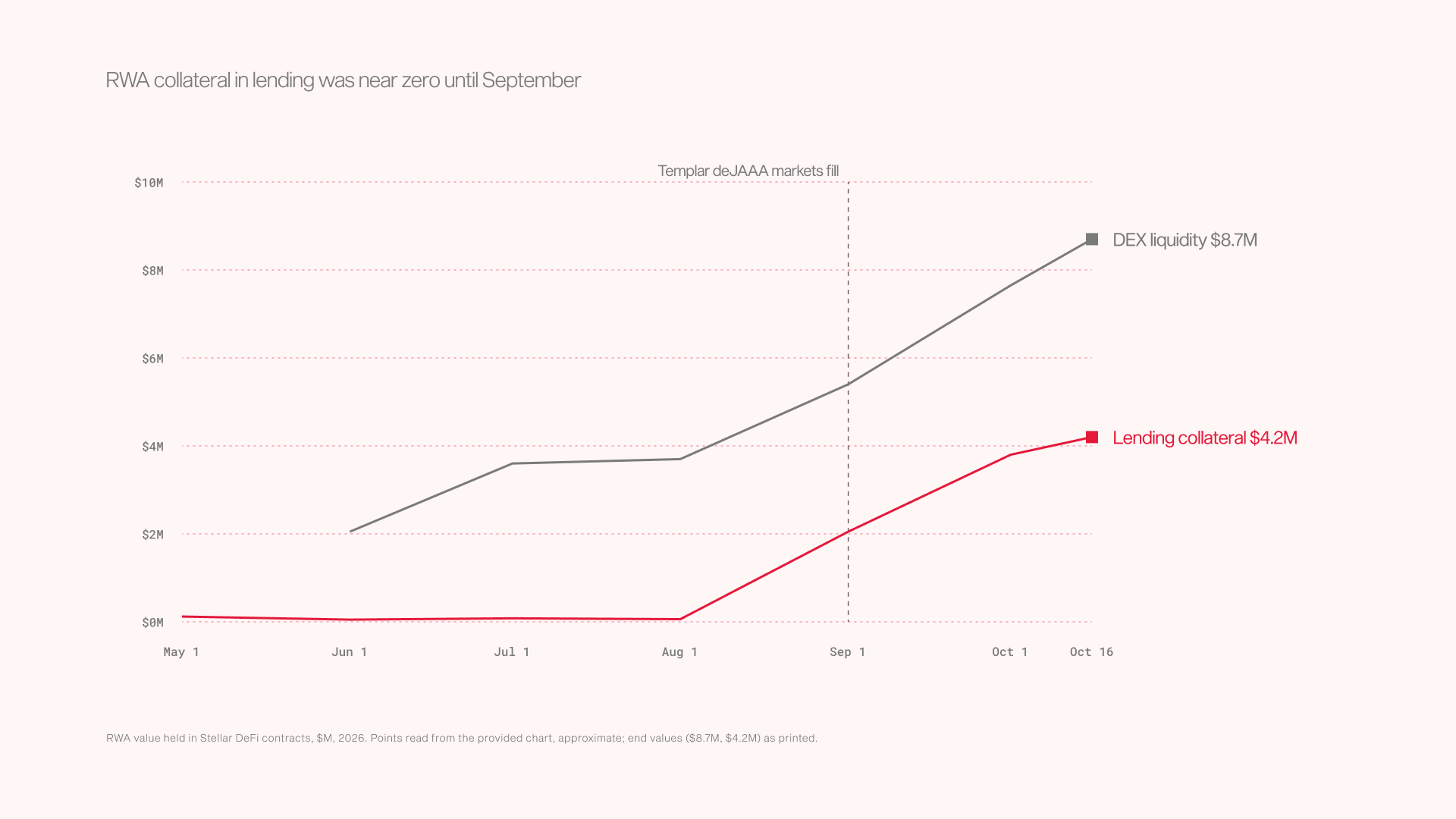
Lending use of RWAs stayed near zero for the first eight months of 2026, while issuance grew from $789M to $3.08B. Then one asset changed the picture: Templar's deJAAA markets went from nothing on August 1 to $2.0M of collateral on September 1 and $4.2M by mid-October.
Figure 3
RWA collateral in lending was near zero until September
RWAs used as lending collateral and DEX liquidity, 2026. Source: rwa.xyz, DefiLlama, Templar onchain snapshots.
Date
RWAs issued (rwa.xyz)
Lending collateral
DEX liquidity
Share in DeFi
Jan 4
$789M
Not measured
Not measured
n/a
Apr 1
$1.48B
$0 on Templar
Not measured
n/a
May 1
$2.12B
$0.12M
Not measured
n/a
Jun 1
$2.71B
$0.05M
$2.1M
0.08%
Aug 1
$3.08B
$0.07M
$3.7M
0.12%
Sep 1
$3.25B
$2.1M
$5.4M
0.23%
Oct 1
$3.37B
$3.8M
$7.7M
0.34%
Oct 16
$3.56B
$4.2M
$8.7M
0.36% (0.40% with Spectra)
Source: rwa.xyz, DefiLlama, Templar onchain snapshots on NEAR.
Before September, lending held only $50K to $120K of RWAs, all CETES and TESOURO in Blend pools. Templar opened its USTRY and CETES markets on March 27 and seeded each with $100K of USDC, but neither has ever held more than about $1K of collateral. DEX liquidity grew steadily, mostly in Aquarius pools, and jumped in September when Sushi pools for deJAAA and deJTRSY opened. Stellar DeFi as a whole grew from $156M to $236M over the year.
The history has two gaps. DefiLlama only started tracking these tokens in late April and May 2026, and it has never tracked USTRY, so January to April figures for Blend and the DEXs aren't available from it. The Templar figures come from the markets' own onchain snapshots and match DefiLlama to within 1%.
2.3Why controls and liquidations don't mix yet
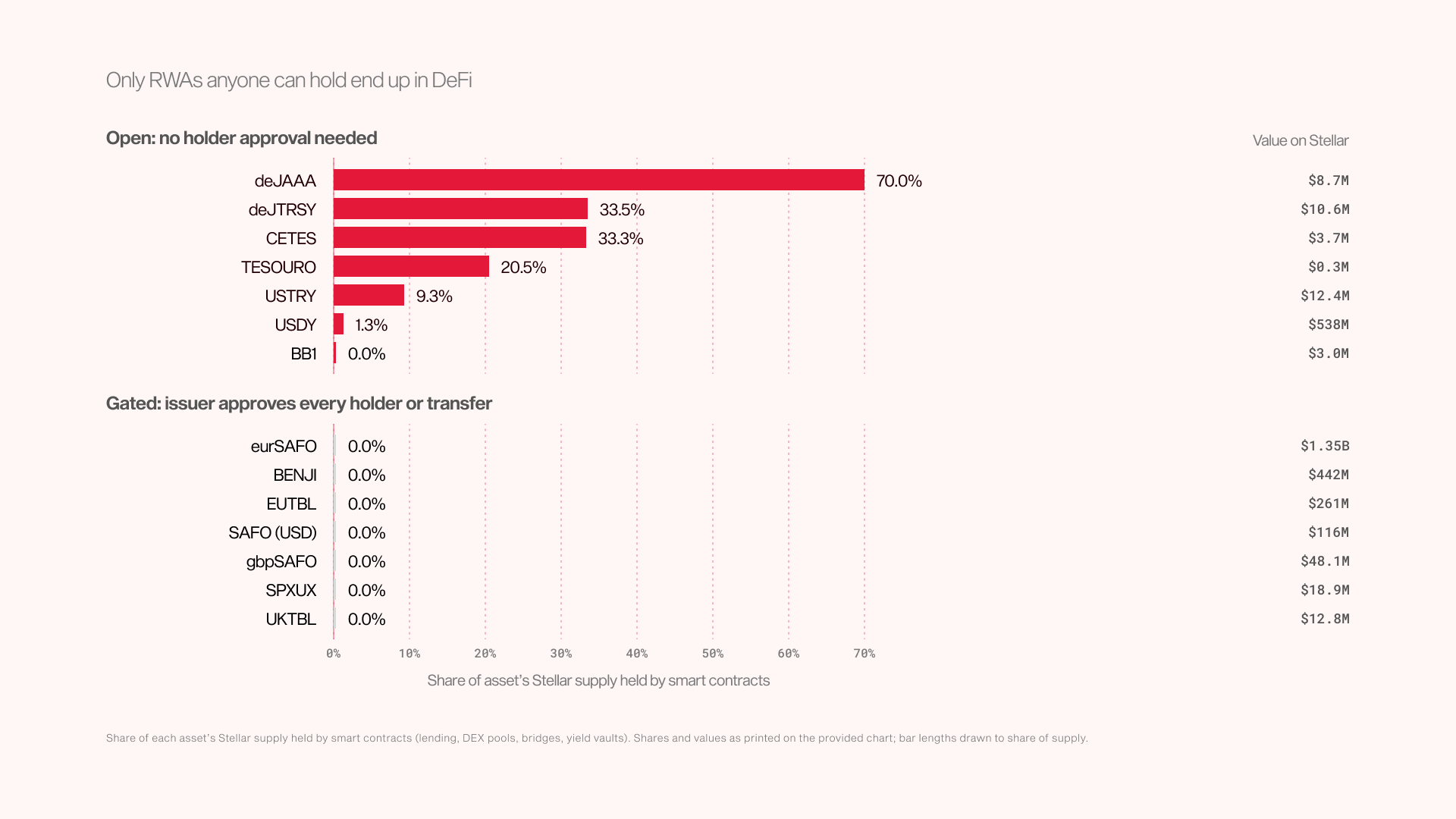
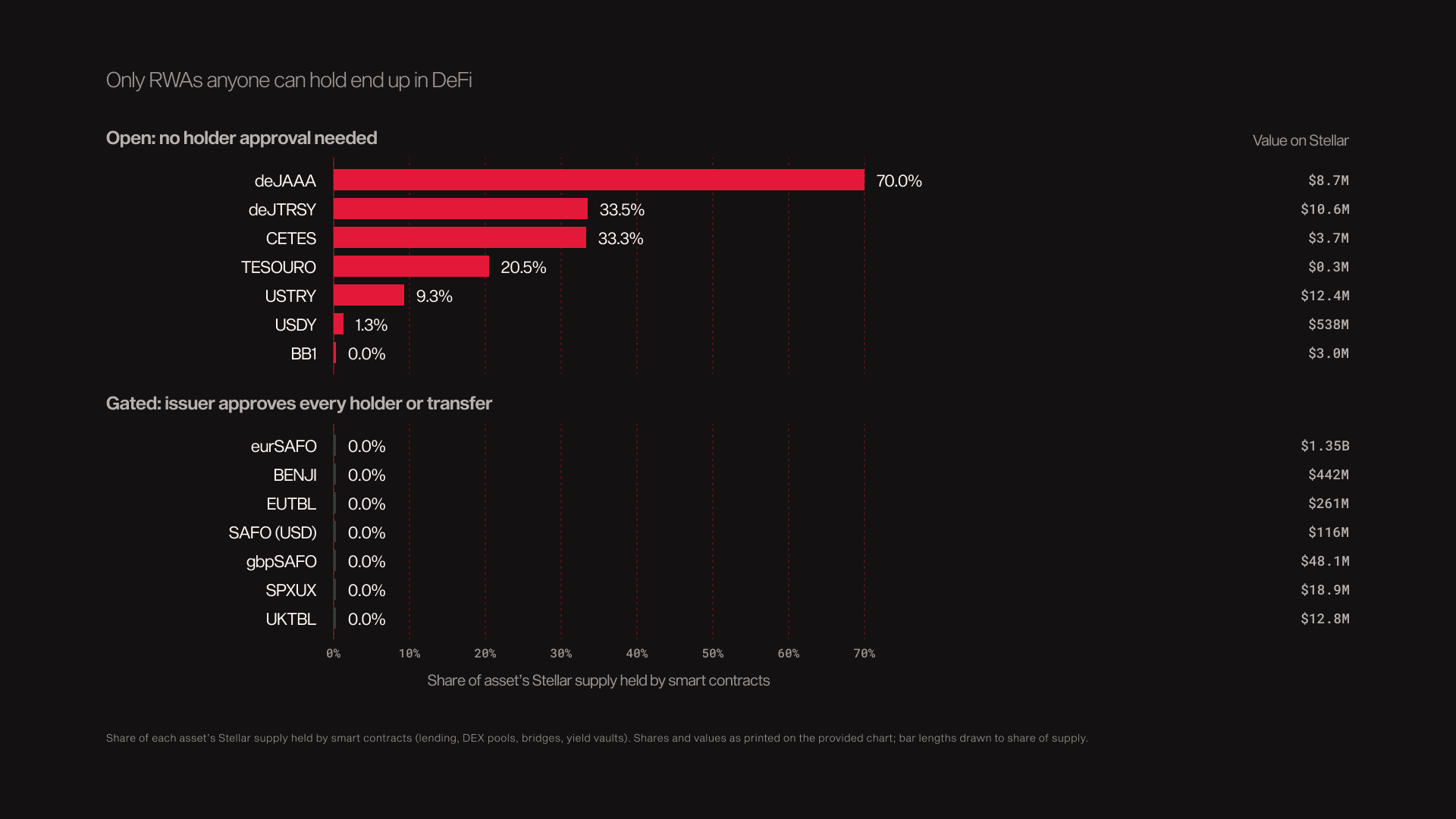
The RWAs that reach DeFi are the ones with the fewest controls. Templar's own market page calls deJAAA "a freely transferable DeFi token." USTRY and CETES need no trustline approval. The assets with the tightest controls show no DeFi use at all. BENJI needs issuer approval for every holder, and Spiko's tokens move only between allowlisted wallets. We checked every holder of the gated assets onchain: none of Spiko's funds (all classes, including the $1.35B eurSAFO), the BENJI family, VuMe, the SpaceX bond or WisdomTree's funds sits in a smart contract.
Figure 4
Only RWAs anyone can hold end up in DeFi
Share of each asset held in smart contracts. Source: StellarExpert, Horizon, October 16, 2026.
The reason is mechanical. A lending market works only if a stranger can step in, repay a bad loan and take the collateral. Each issuer control breaks part of that:
Authorization required. The liquidator needs an approved trustline before it can receive the collateral. A permissionless liquidator bot can't get one in advance, and the pool contract needs its own approval too.
Freeze. The issuer can freeze the pool's balance. A frozen position can't be seized or sold, so lenders are left holding an unsecured loan.
Clawback. The issuer can pull collateral out of the pool after a court order or sanctions. The loan remains, with nothing behind it.
Redemption-only exits. Even a liquidator who can hold the token often can't sell it onchain. It has to redeem with the issuer on the fund's schedule, which turns a liquidation into a wait of a day or more.
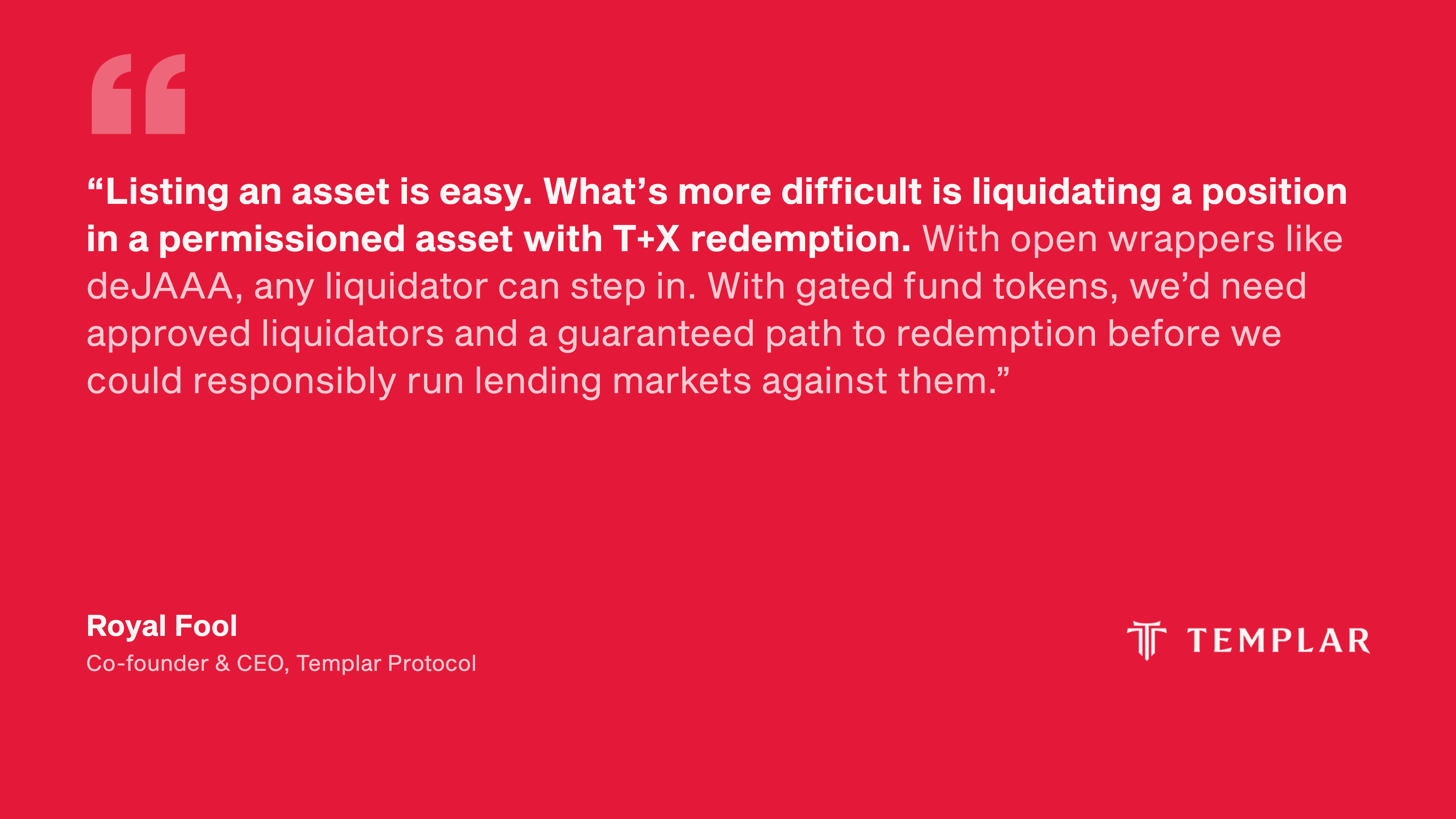
So risk teams either set very conservative terms or skip the asset. The wrappers that do make it into DeFi, such as deJAAA, are built to drop these controls. A third route keeps the controls and makes the liquidator a known party: an auction among KYC'd liquidity providers that the issuer has approved in advance. That is the model behind RedStone Settle, which the conclusion returns to.
03
Mapping the Redemption Rules
Almost every large RWA on Stellar can be redeemed, but only by holders the issuer has approved, and usually on the fund's daily schedule. A liquidator who isn't on that list can only sell onchain. For most of the $3.56B, there is no onchain market to sell into.
3.1Redemption rules by asset
Asset (category)
Value on Stellar
Redemption
Who can hold and redeem
Transfers
Onchain exit: sell $100K into USDC
Spiko SAFO share classes (overnight swap fund)
$1.53B
Daily at NAV, T+1; gate at 10% of net assets
Non-US investors, KYC'd
Allowlisted wallets only
No market
Spiko EUTBL, USTBL, UKTBL (T-bill funds)
$307M
Daily, morning Paris cut-off; same 10% gate
Non-US investors, KYC'd
Allowlisted wallets only
No market
Ondo USDY (Treasury note)
$537M
Daily; wire sent T+2 to T+3
Non-US investors, KYC at subscription
Free after a 40-day lock on new subscriptions
10% loss via Aquarius ($10K sale: 2.5%)
Franklin Templeton BENJI (US government money fund)
$526M
Daily
US investors, KYC via Benji
Approved wallets only
No market
Realiz VuMe Bond 2030 (corporate bond)
$500M
Only at maturity
Non-US professional investors
Allowlisted wallets only
No market
NYALA SpaceX bond
$27M
None; held to January 2029
Non-US investors
Allowlisted wallets only
No market
WisdomTree funds
$40M
Daily
US investors
Allowlisted wallets only
No market
Centrifuge deJAAA, deJTRSY
$19M
Daily via Centrifuge, $1,000 minimum
Non-US professional investors (to redeem)
Free, with a blocklist
DEX pool only (deJAAA)
Etherfuse USTRY, CETES, TESOURO
$16M
Instant via Etherfuse app or SDK
Non-US investors, KYC to redeem
Free
USTRY 0.1%, CETES 0.3%, TESOURO 47% loss
Liqvid receivables
$10M
Gated, after a 4-month soft lockup
Non-US professional investors
Allowlisted wallets only
No market
Terms come from rwa.xyz's asset records and, for Spiko, the SICAV prospectus. NAV is a fund's net asset value per share; T+1 means cash arrives one business day after the request. Exit costs are the better of Horizon strict-send quotes (Stellar DEX and classic pools) and Aquarius router quotes (Soroban pools).
The pattern is clear. The more the issuer controls who holds the token, the less onchain liquidity it has. About 83% of Stellar's RWA value sits in assets with no onchain market at all. USDY, another 15%, can be sold onchain only at a discount that grows fast: about 2.5% on $10K and 10% on $100K, through Aquarius pools. Etherfuse is the exception: its USTRY and CETES books quote spreads of 4 to 5 basis points (0.04% to 0.05%) with about $260K of bids within 2% of the price. Those books were deep enough to absorb a $100K sale for 0.1% to 0.3% on the day we checked. That depth is maintained by market makers, though, so it can thin out when they step back.
3.2What an exit actually looks like
Suppose a lending pool were left holding $1M of BENJI from a defaulted loan. It can't sell onchain, because there are no bids. It can't send the tokens to a trading desk unless Franklin Templeton has approved the desk's wallet. The only way to get cash is to redeem with Franklin Templeton, and a smart contract can't do that: redemption requires a KYC'd US investor with an account on Benji, Franklin Templeton's investor app. So someone offchain would have to redeem on the pool's behalf, submit the request and wait for the fund's once-a-day processing to get paid. A Spiko position is similar: daily NAV, T+1 cash, allowlisted wallets only, and a 10% gate that can defer redemptions for up to a month in a run.
For USDY, a liquidator can sell onchain through Aquarius pools, but each sale moves the price against it: about 2.5% on $10K and 10% on $100K. Its other option is to redeem with Ondo as a non-US KYC'd holder and wait two to three business days for a wire. Etherfuse is the only issuer here whose tokens a liquidator can turn into USDC in seconds at close to par, onchain or through instant redemption.
3.3Cautious terms: listed or not, not lower LTVs
You might expect redemption risk to show up as lower LTVs. On Stellar today, it shows up mainly in whether an asset gets listed at all, and in how much its market is allowed to grow.
Templar market (collateral)
Liquidates at collateral ratio
Implied max LTV
deJAAA, deJTRSY
105%
~95%
USTRY
111%
~90%
BTC (bridged)
111%
~90%
CETES
118%
~85%
SolvBTC, ADA, DOGE
120%
~83%
XLM
133%
~75%
ZEC
154%
~65%
Source: each market's get_configuration on NEAR, October 16, 2026.
Templar gives its open RWA wrappers some of its most generous terms, because their prices barely move. Its caution shows up elsewhere. The USTRY and CETES markets each have $100K of USDC supplied but almost no use: $223 and $34 borrowed, against about $380 of USTRY and $80 of CETES posted as collateral. And none of the large funds is listed: not BENJI, Spiko, USDY or VuMe. Blend has no live RWA collateral factor to compare.
3.4Case study: Venus and tokenized stocks
Venus is the cleanest public example of a risk team pricing an RWA by its exit rather than its volatility. It isn't on Stellar, but it faces the same problem: an asset with a reliable price whose exit is set by an issuer.
In June 2026, Binance launched bStocks, tokenized US equities such as Tesla (TSLAB) and Nvidia (NVDAB), issued by BTech Holdings. Minting and redemption run through the issuer, for eligible users only. The underlying stocks trade about 6.5 hours a day, five days a week, while the tokens trade around the clock.
Venus proposed the markets on June 16 and listed them on June 20 in its BNB Chain Core Pool:
Parameter
TSLAB (Tesla)
NVDAB (Nvidia)
SPCXB (SpaceX)
Collateral factor (max LTV)
60%
60%
50%
Liquidation threshold
70%
70%
65%
Liquidation incentive
10%
10%
10%
Supply cap at launch
236 tokens
450 tokens
500 tokens
Source: Venus community proposal, June 2026.
The collateral factor caps how much a user can borrow against the token; the liquidation threshold is the loan-to-value at which the position is liquidated. Each parameter is set by the exit shape:
Weekend gaps. Venus runs 24/7, but Tesla stock doesn't. If Tesla gaps 15% at Monday's open, a position that looked safe on Friday may already be underwater. A 60% collateral factor leaves room for that gap.
Who can take the collateral. A liquidator receives the bStock. To turn it into cash at par, it needs either a buyer on Binance or PancakeSwap, or eligibility to redeem with BTech. The 10% incentive pays for that friction.
How much can be sold. Supply caps of a few hundred tokens keep any liquidation small enough for secondary markets to absorb.
The contrast with Stellar makes the point. Templar lets deJAAA, a wrapper on a AAA CLO fund, borrow at about 95%. Venus holds Tesla and Nvidia, two of the most liquid equities in the world, to 60%. On price alone, it should be the other way around. But risk teams are pricing the confidence in an exit, and for an RWA, the exit is set by the issuer's redemption rules and the hours of the underlying market. The token's price chart is more of an afterthought here.
04
The Risk Layers
The second gap is harder to see. A credit rating on a tokenized fund's holdings describes those holdings. It says nothing about the wrapper, the bridge, the lending market and the vault stacked on top of it.
4.1One asset, six layers
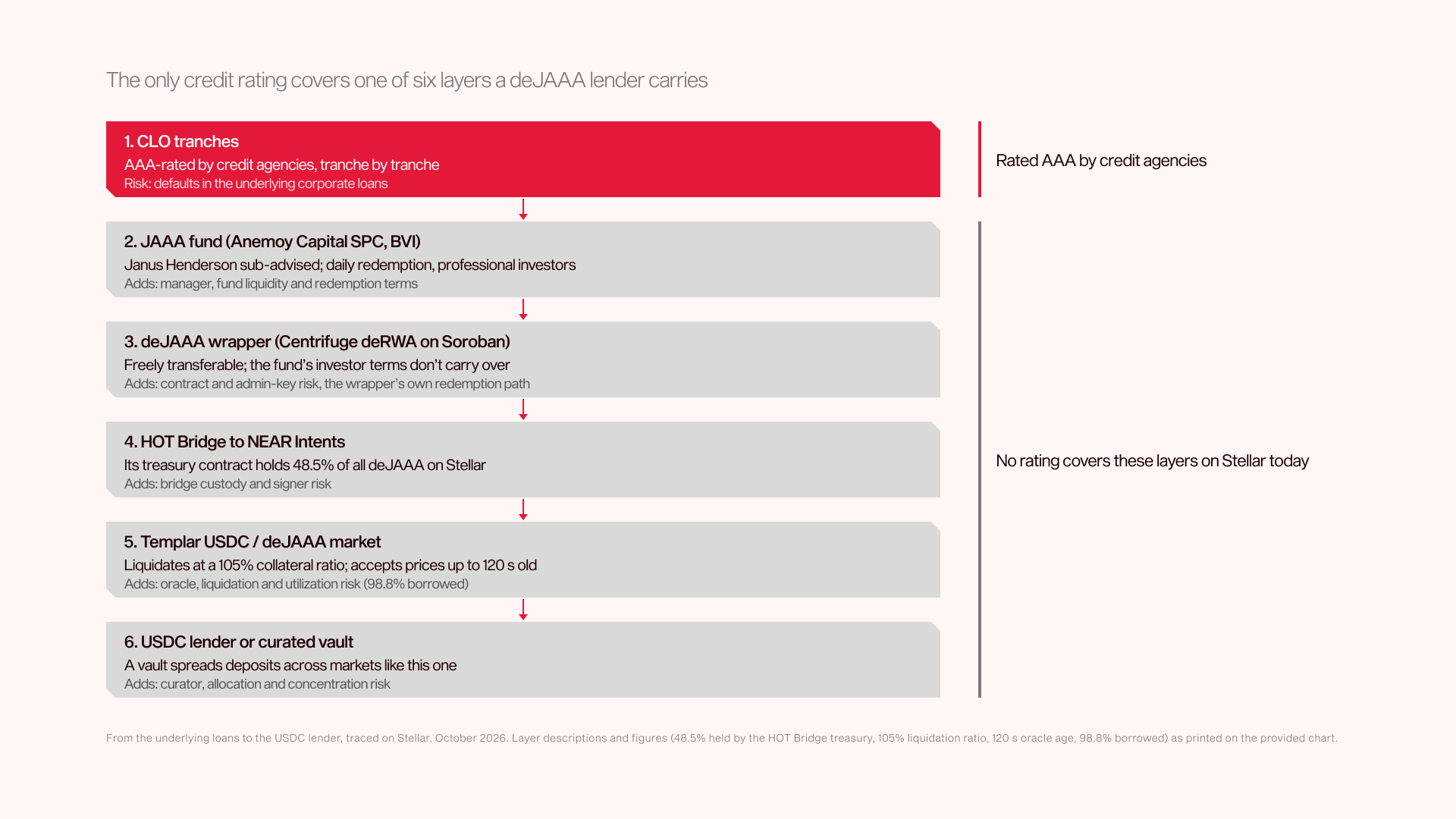
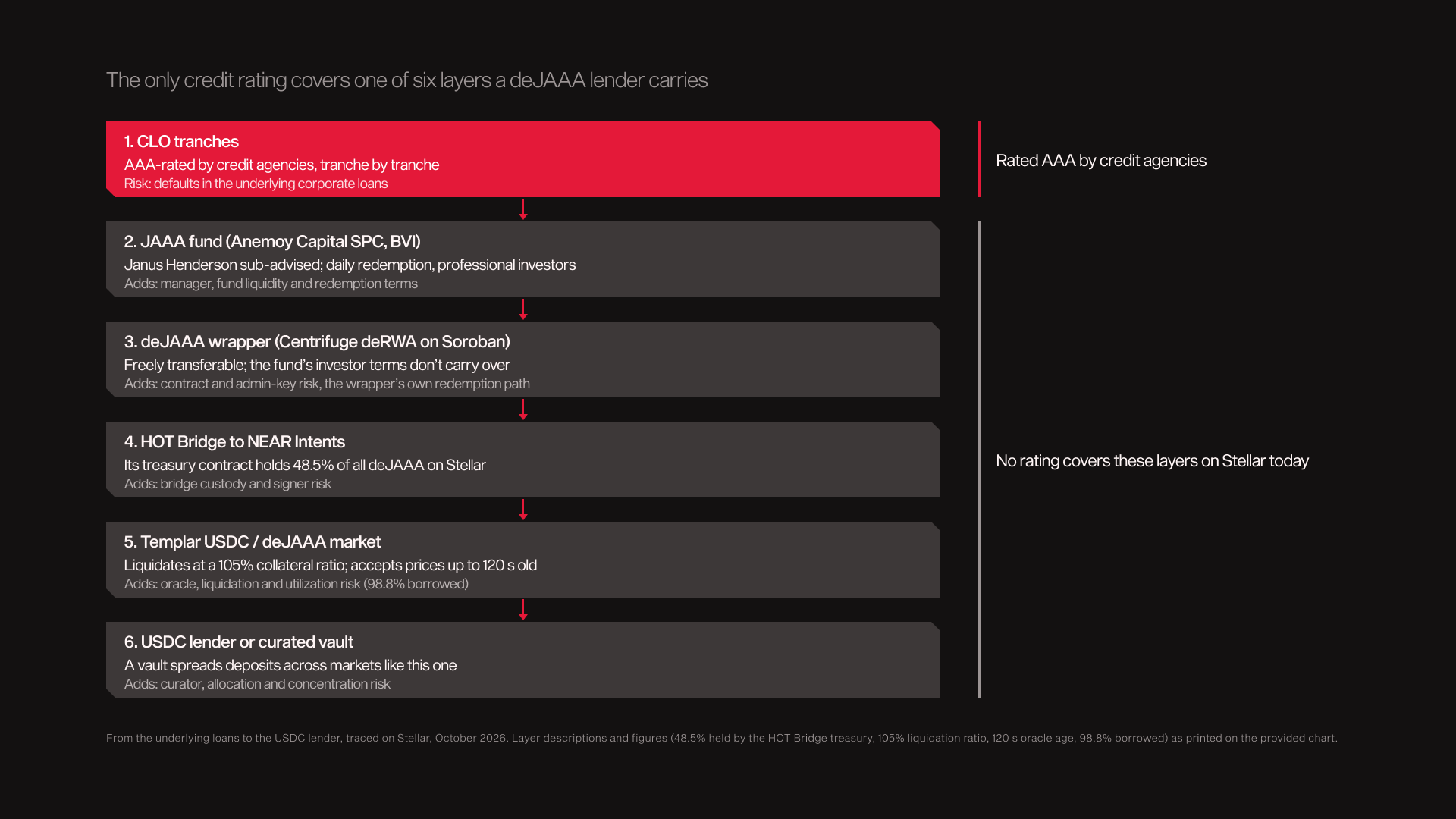
Take the one RWA that Stellar DeFi actually uses. A USDC lender in Templar's deJAAA market is told it is lending against AAA CLOs. Trace it onchain, though, and that AAA covers only the first layer of what the lender is exposed to.
Figure 5
The only credit rating covers one of six layers a deJAAA lender carries
Risk layers in a Templar deJAAA loan. Source: RedStone research.
Each layer adds a new risk:
The CLO tranches. Credit agencies rate each tranche, and the fund buys AAA. This is the only layer a traditional rating speaks to directly.
The fund.JAAA is a segregated portfolio of Anemoy Capital SPC in the British Virgin Islands, audited by MHA Cayman, with Janus Henderson as sub-adviser. Its redemption rules, liquidity, and manager quality matter, but a rating of its holdings doesn't price them.
The wrapper. deJAAA is a Centrifuge deRWA token on Soroban. Templar's own market page warns that it "is a separate instrument from the fund's own shares, so the fund's investor terms do not carry over to it." The holder now carries contract risk, admin-key risk, and the wrapper's own redemption path.
The bridge. Templar's lending engine runs on NEAR, so the collateral leaves Stellar. HOT Bridge's treasury contract holds 48.5% of all deJAAA on Stellar, which means half of the asset's supply now depends on a bridge's custody and signers.
The lending market. Templar's two deJAAA markets liquidate at a 105% collateral ratio and accept oracle prices up to 120 seconds old. The larger market is 98.8% borrowed. A 5% fall in deJAAA's price, or a bad price print, can push borrowers to liquidation. If liquidators can't sell or redeem the collateral fast enough, the loss falls on the USDC lenders.
The vault. Many lenders don't pick markets themselves. They deposit into a curated vault that spreads USDC across markets. Stellar already has curators and allocators: Gami Labs ($29M), Upshift ($29M), and DeFindex ($19M). A depositor's risk then depends on the curator's choices, caps and concentration.
By layer five, the risk profile is clearly not equal to that of a AAA bond, the lender holds something closer to a leveraged, bridge-dependent position. That is true even if every CLO underneath performs perfectly.
4.2Rating each layer
The fix is to rate the stack, not just the asset. Credora by RedStone already does this for Morpho on EVM chains:
Collateral. Each token gets a probability of default under a token methodology, with proxy ratings for unrated assets.
Market. Loan-pair and liquidation simulations produce a Probability of Significant Loss (PSL): the chance the market takes bad debt above 1% of principal. An oracle-risk modifier and a protocol smart-contract adjustment are applied on top.
Vault. Market PSLs are weighted by the vault's allocations, then adjusted for the curator, governance, guardian and timelock.
05
The DTCC Unlock
DTCC is about to bring the most controlled assets in finance to Stellar, at a scale that dwarfs today's market. DTC custodies $114 trillion in securities. If 0.1% of that moved onchain, it would be $114B, about 30 times all the RWAs on Stellar today. Every gap in this report is a preview of what those assets will meet.
5.1What's coming
December 11, 2025. SEC staff issued a no-action letter allowing DTC to run a tokenization service for three years from launch.
May 27, 2026. DTCC and SDF announced plans to tokenize DTC-custodied assets on Stellar, the first public chain in DTCC's multi-chain strategy. Nadine Chakar, global head of DTCC Digital Assets, said Stellar's "emphasis on compliance, transaction throughput and low-cost operations meets our rigorous standards".
Second half of 2026. DTC's pilot goes live.
First half of 2027. Tokenized DTC-custodied assets are expected on Stellar.
The eligible assets are deliberately liquid: Russell 1000 stocks, ETFs tracking major indices such as the S&P 500 and Nasdaq 100, and US Treasury bills, notes, and bonds.
5.2The most restrictive exit profile on the network
The no-action letter calls these tokens Tokenized Security Entitlements, and its conditions make them more controlled than anything on Stellar today:
Registered wallets only. Only DTC participants, mainly broker-dealers and banks, can register wallets, and tokens can move only between registered wallets. Everyone else holds through a participant.
A root wallet that overrides holders. DTC keeps a root wallet on each chain that can transfer, mint or burn tokens without the holder's key, to correct errors, lost tokens or misconduct.
An off-chain official record. Ownership lives in DTC's own records. The chain is an instruction layer that updates them.
No collateral value inside DTC. In the letter's words, "DTC would not give collateral or settlement value to Tokenized Security Entitlements." They also sit outside DTC's normal delivery-versus-payment settlement.
There are two ways out. A holder can sell to another registered wallet, or burn the token and have the security re-credited to a participant's account at DTC. Both run through DTC participants. Compared with the assets in the redemption table, this is BENJI's whitelist, plus a root wallet stronger than clawback, plus an exit that only a regulated participant can use.
5.3Why it makes every gap more urgent
Gap in this report
Today, at $3.56B
With DTC assets
DeFi utilization
Gated assets have 0% in smart contracts
A lending pool, its liquidators, and any vault need registered wallets, through a DTC participant
Redemption and exit
83% of value has no onchain market
Exits run only through DTC participants; Russell 1000 stocks trade about 6.5 hours a day
Risk layers
No rating covers wrapper, bridge, market or vault
A token that is an entitlement, an off-chain record and a root wallet add layers before any DeFi wrapper does
Pricing
SEP-40 feeds price RWAs that trade intermittently
Thousands of equities and Treasuries need 24/7 prices for markets that close nights and weekends
The Venus case shows what risk teams do with this profile: they list the asset and hold it to 50 to 60%. The deJAAA case shows the other route: an open wrapper that DeFi can use, carrying every risk layer that comes with it. DTC's assets will need one of the two, at a scale where the choice matters. The report's conclusion looks at what closes the gaps before 2027.
06
Conclusion
Stellar has solved issuance. The next task is making $3.56B in RWAs usable without stripping out the controls that brought issuers here. Each gap in this report has a specific fix, and most of those fixes already exist somewhere.
Gap
What's missing on Stellar
Remedy
Liquidation access
No approved buyer for gated collateral, so gated assets have 0% in DeFi
A gated asset can't be liquidated by an anonymous bot, but it can be liquidated by a known one. RedStone Settle runs liquidations as an auction among liquidity providers that are "KYC-verified and whitelisted for each specific RWA token type." The winning liquidity provider repays the debt and takes the collateral in one atomic transaction. The lending market gets cash at T+0, and the liquidity provider holds the asset through the issuer's redemption window, earning the auction discount.
This works with Stellar's flags rather than against them. An issuer using authorization-required can pre-approve liquidity provider wallets the same way it approves investors, and clawback and freeze stay in place. Liquidity providers' capital can come from institutional OTC desks, purpose-built settlement vaults or Symbiotic vaults. Symbiotic's Liquid Lane, launched in June with Midas as its first issuer, already uses vault capital and KYC-verified market makers to pay out tokenized-asset redemptions in USDC instantly. Settle runs on EVM chains today. Bringing it to Soroban is the step that would let BENJI, Spiko's funds and, in time, DTC's assets back a loan on Stellar.
6.2Pricing that holds when markets close
Settle needs a price to trigger on, and the YieldBlox exploit showed what happens when that price comes from a thin order book. SEP-40 gives Stellar a standard way to read timestamped prices from more than one provider. The next step is coverage: feeds for the gated funds that hold most of Stellar's value, and clear rules for pricing equities and Treasuries overnight and on weekends.
6.3A rating for every layer
A AAA on the underlying tells a lender little about a 95% LTV market on a bridged wrapper. Credora by RedStone rates the stack (collateral, market and vault), each with a probability of significant loss that includes oracle and protocol risk. Applied to Stellar's lending markets and vaults, it would give lenders a number for the layers they actually hold.
Together, these turn Stellar's controls from the reason DeFi avoids RWAs into the reason institutions can trust DeFi with them. That matters most for DTCC: its assets arrive in 2027 with the tightest exit profile on the network.