SPLUS’s Reserves Are Now Independently Verified by RedStone
Table of Contents (6 sections)
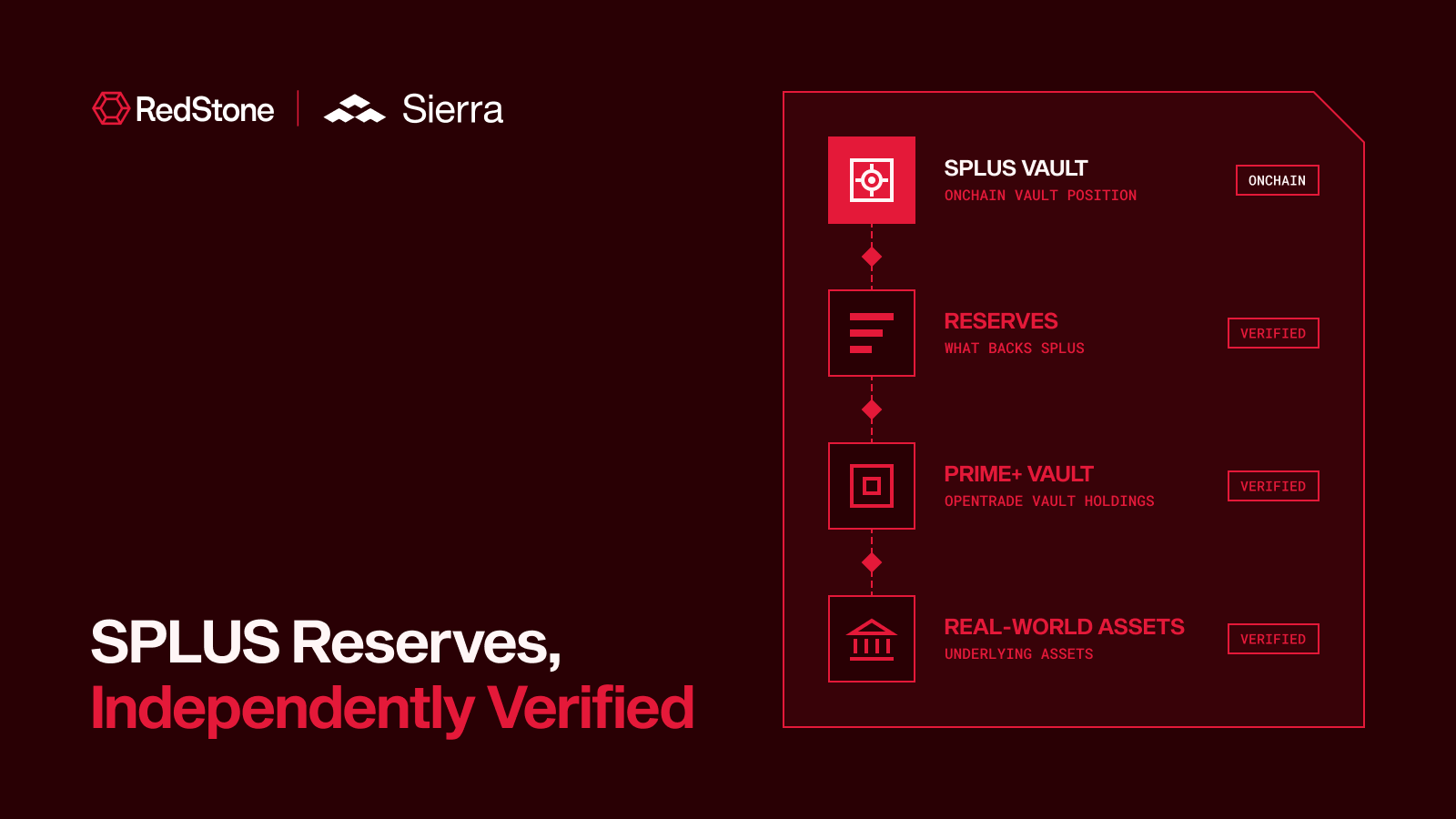
RedStone has launched a Proof of Reserve dashboard for SPLUS, allowing anyone to check the reserves backing the SPLUS vault.
A Proof of Reserve Dashboard for SPLUS
SPLUS is a vault issued by Sierra Protocol on Ethereum in August 2026. It has one reserve asset: OpenTrade’s USDC Prime+ vault, an actively managed RWA portfolio run by UK-regulated asset manager Five Sigma Finance. Prime+ can hold mortgage-backed securities, collateralized loan obligations, money market funds and commercial paper.
That structure is what gives SPLUS its yield, and also what makes it hard to verify directly onchain. The assets sit offchain, inside a vault run by a third party. Onchain, a holder can see that SPLUS owns shares in Prime+, but not what those shares are backed by. Until now, the rest of the picture depended on what Sierra and OpenTrade reported.
For anyone depositing into the vault, that leaves two questions: is it fully backed, and if so, by what? RedStone’s SPLUS Proof of Reserve dashboard is now live to answer both. It tracks the reserves behind SPLUS against the vault’s supply and breaks down what they hold, down to the real-world assets inside the vault. RedStone reads the data and publishes it on a public page anyone can open. Since SPLUS redemptions are paid in USDC from those same reserves, holders can also see that what they would redeem against is there.
How the Verification Works
SPLUS’s backing sits in two places. Its reserves, read onchain, are almost entirely shares in the Prime+ vault, and those shares are backed by the real-world assets Prime+ holds offchain. The dashboard checks both, in two sections with their own collateralization ratio.
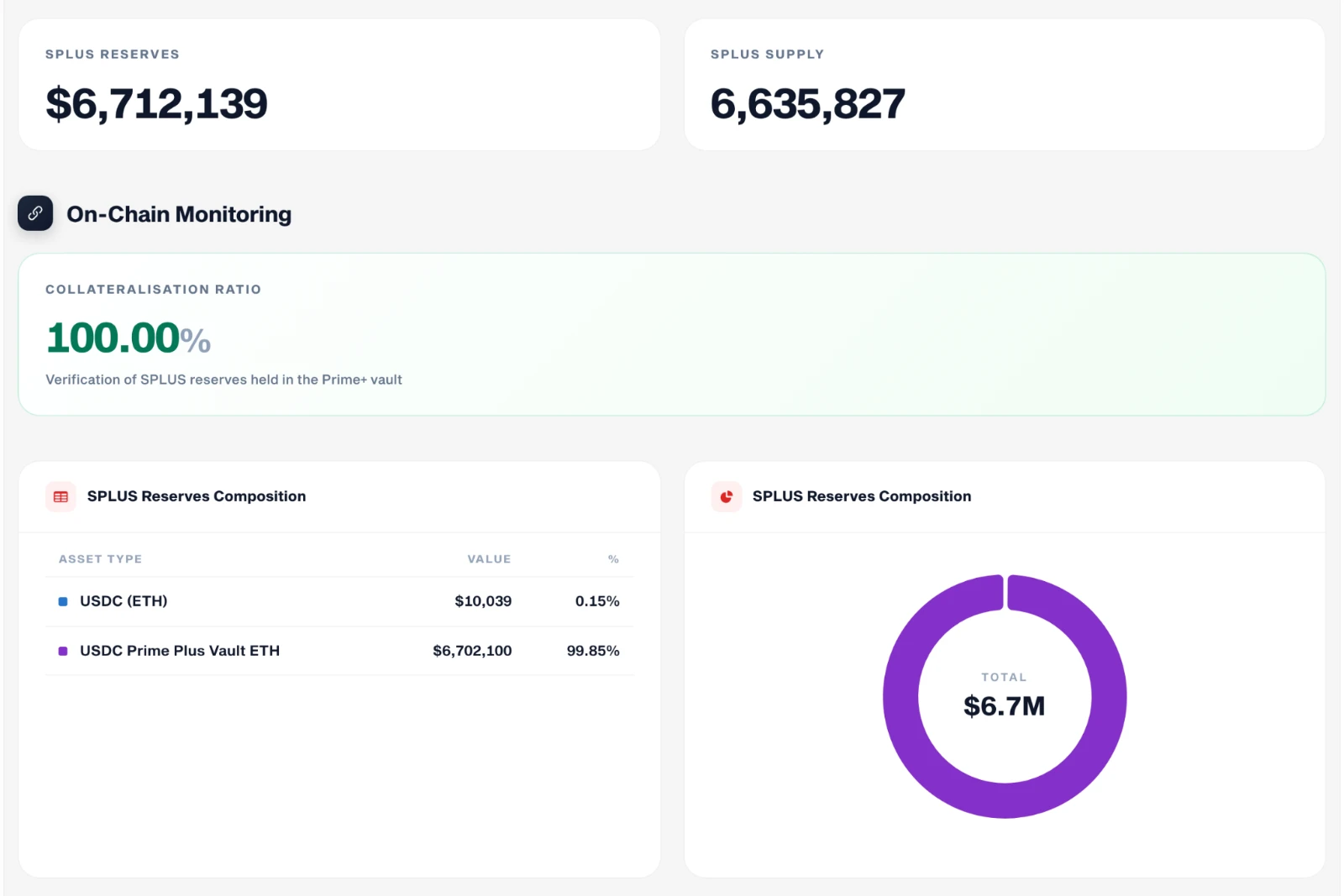
The first section, On-Chain Monitoring, compares SPLUS’s onchain reserves with the value of every SPLUS token in circulation. Its SPLUS Reserves Composition shows what those reserves are: a position in the Prime+ vault and a small USDC balance. At the time of writing, the reserves covered the supply at 100%.
The second section, RWA Reserves, opens up that vault position. Its Prime+ Reserves Composition uses OpenTrade’s own vault data to show the RWA reserves behind SPLUS’s share of Prime+. At the time of writing, that was nearly all a money market fund plus some cash, covering the vault position at 100.04%. Because those assets are reported offchain, this section updates weekly and shows the date of the latest data.

Why This Matters
SPLUS gives DeFi users permissionless access to TradFi yield from credit and funds, and that yield is earned off the chain. So anyone considering SPLUS needs a way to see that the reserves exist: holders, lending markets weighing it as collateral, curators building vaults around it, and the integrators who list it.
A public, independent reserve check gives all of them the same view, and they can monitor it themselves. For Sierra, the dashboard turns transparency into something users can open at any time. It also gives integrators a public reference when they assess SPLUS for listings or collateral.
For RedStone, SPLUS extends Proof of Reserve to a token whose backing is an actively managed RWA vault, verified down to the vault’s own holdings. It builds on reserve verification RedStone already runs for Lombard’s LBTC and Ethena’s USDtb, as well as on the independent dashboard RedStone built for Radiant Prime.
This partnership builds on the onchain NAV feed for Sierra’s flagship vault, SIERRA, that is powered by RedStone. That feed brings SIERRA’s reported value onchain so lending markets can price it. Proof of Reserve does a different job: instead of passing on a value, it independently checks that the assets behind the token are there.
You can see the SPLUS reserves live on the dashboard.
About RedStone
RedStone is the data layer for institutional DeFi, delivering secure, low-latency price feeds for digital assets, RWAs, stablecoins, LSTs, LRTs, and Bitcoin LSTs across 110+ chains. Trusted by 200+ clients, including Securitize, Morpho, Pendle, Spark, Ether.fi, Ethena, Lombard, Venus, and Compound, RedStone powers lending, stablecoins, perpetuals, and tokenized asset markets with custom pricing infrastructure built for complex onchain systems. RedStone provides data for tokenized products including BlackRock’s BUIDL, Apollo ACRED, and Hamilton Lane SCOPE. Zero mispricing events. 100% uptime. Learn more at redstone.finance.
About Sierra
Sierra is an institutional-grade RWA vault protocol that lets neobanks, fintechs and wallets offer stablecoin yield derived from assets from a network of 50+ financial institutions, and enables institutional asset issuers to extend their products into permissionless, composable markets. Learn more at https://docs.sierra.money/.
Frequently Asked Questions
What is SPLUS?
SPLUS is a vault issued by Sierra Protocol. It went live on Ethereum in August 2026 and gives anyone permissionless access to OpenTrade’s Prime+ vault, an actively managed RWA portfolio run by Five Sigma Finance. Holders mint and redeem without permission, and redemptions are paid in USDC.
What does the SPLUS Proof of Reserve dashboard show?
It checks SPLUS’s onchain reserves against the value of all SPLUS in circulation, then looks inside Prime+ at the real-world assets behind SPLUS’s position there. RedStone reads the onchain reserves directly from the chain. The RWA reserves come from OpenTrade’s own vault data, update weekly and carry the date of the latest figures. As of 9 November 2026, the onchain reserves stood at 100.00% and the RWA reserves at 100.04%.
Does the dashboard cover the whole Prime+ vault?
No. Prime+ has other depositors, including a portion of the reserves backing SIERRA. The RWA section shows only SPLUS’s share of the vault’s holdings, which is why its total matches SPLUS’s vault position and not the size of the whole vault.
How is this different from the NAV feed RedStone already runs for Sierra?
The NAV feed takes the value Sierra reports for the SIERRA vault and puts it onchain, so lending markets can price them. Proof of Reserve checks that the assets behind SPLUS are actually there and shows what they are.